
Archbishop Gallagher: Vatican diplomacy has served peace for centuries
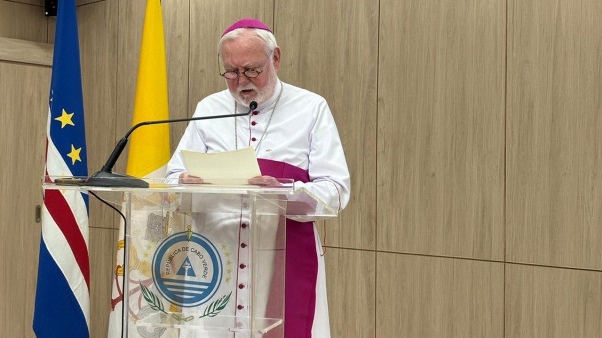 In Cape Verde for the 50th anniversary of diplomatic relations with the Holy See, Archbishop Gallagher, Secretary for Relations with States and International Organizations, delivers a speech in which he explores the working methods of papal diplomacy.
Archbishop Gallagher at the conference held on Monday, May 11, in Cape Verde
Defense of life, the family, religious freedom, human rights, democracy, multilateralism, and international law constitute the “fundamental values” shared by the Holy See and Cape Verde.
Alongside these are major “global challenges” such as conflicts, the climate crisis, inequalities, migration, technological transformations, drug trafficking, a crisis of values, individualism, and the loss of a sense of truth.
This was the overall picture outlined by Archbishop Paul Richard Gallagher, Secretary for Relations with States and International Organizations, in the conference held on Monday, May 11, in Cape Verde.
He is visiting the African island republic until May 14 on the occasion of the 50th anniversary of diplomatic relations between the Holy See and the country.
The central objective of peace
“Half a century of dialogue, cooperation, and genuine friendship between a young sovereign state and one of the oldest diplomatic institutions in the world,” the prelate highlighted in his speech in Spanish.
He emphasized that papal diplomacy is strengthened by “a long historical tradition” geared toward the “central objective” of peace and the defense and promotion of the dignity of the human person.
In this regard, he then recalled the origins of papal diplomacy in the 11th century, during the Gregorian Reform, with the institutionalization within the Church of the “right of legation.”
He then underlined the institutional stability achieved in the 15th century, with the transition — later adopted by other States as well — from occasional missions to permanent ones, a central feature of modern diplomacy.
Lastly, he focused on the consolidation of papal diplomacy in the 16th and 17th centuries, highlighting the distinction between nuncios, legates, and internuncios.
The diplomatic relations of the Holy See
Currently, “the Holy See maintains diplomatic relations with 184 States, in addition to the European Union and the Sovereign Military Order of Malta,” and there are 93 diplomatic missions accredited to the Holy See and based in Rome, Archbishop Gallagher continued.
He explained the working methods of papal diplomacy and the functioning of the Secretariat of State in its mission of service to the Pope.
Within the experience developed over centuries “in the service of peace, justice, and the defense and promotion of human dignity,” he noted, relations with the Republic of Cape Verde began even before the country declared independence in 1975.
Archbishop Gallagher recalled the audience granted by Pope Paul VI on July 1, 1970, in the Vatican to several leaders of African independence movements, including Agostinho Neto, Marcelino dos Santos, and Amílcar Cabral.
The Secretary for Relations with States stressed that the meeting “led to the temporary interruption of relations with Portugal, but showed the Church’s courageous commitment to supporting the African cause and the dignity of peoples.”
The Church in Cape Verde
The presence of the Church, meanwhile, is rooted in the Republic of Cape Verde’s history and forms part of its identity. Catholic missionaries, among the first inhabitants of the African archipelago in 1462, profoundly influenced its culture, art, music, and customs.
It was in 1533 that the Diocese of Santiago de Cabo Verde was established, the first in sub-Saharan Africa, making the land “a center of evangelization and social organization, with schools, hospitals, and educational institutions,” Archbishop Gallagher continued.
Far from proposing “political or economic systems,” the Church asks “that human dignity be respected and that it be guaranteed freedom to carry out its mission,” clarified the Secretary for Relations with States.
In this context, he referred to the 2013 Agreement between the Holy See and Cape Verde, aimed at ensuring assistance especially in the areas of health and education.
Relations founded on love and truth
Archbishop Gallagher also encouraged the promotion of a “diplomacy of hope and values,” putting into practice the Pope’s appeal for a “disarmed and disarming peace” through “relations founded on love and truth.”
Lastly, he encouraged the leaders and people of Cape Verde to “persevere in the pursuit of the common good, justice, unity, and solidarity.”
Also on Monday, in the presence of Archbishop Paul Richard Gallagher, the Protocol for the Implementation of the 2013 bilateral Agreement was signed by the local Church.
Lorena Leonardi
Source: vaticannews.va/en