
Archbishop of Monaco: Pope Leo XIV will help us recognize ‘hidden poverties’
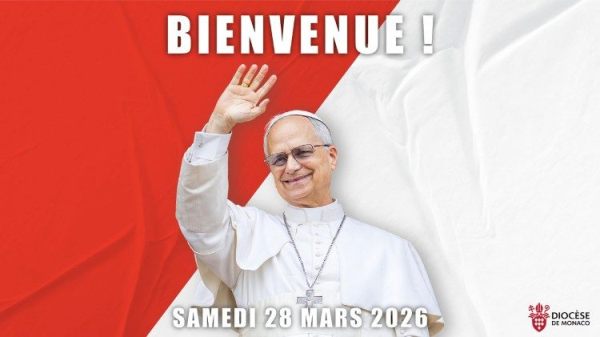 Ahead of Pope Leo XIV’s Apostolic Journey to Monaco, Archbishop Dominique-Marie David tells Vatican News about the spiritual fragilities of the small country where wealth often conceals deep “loneliness” and a “crisis of the meaning of life.”
Logo of the Pope9;s Apostolic Journey to Monaco
Pope Leo XIV embarks on his one-day Apostolic Journey to the Principality of Monaco on Saturday, March 28.
Often seen as an elite hub, the wealth of visitors to the tiny European country on the French Riviera conceals a hidden loneliness and anxiety, according to Archbishop Dominique-Marie David, Archbishop of Monaco.
In the following interview with Vatican News ahead of the Pope’s visit, Archbishop David offers his understanding of the Church’s spiritual mission in a city of luxury.
Q: Your Excellency, one aspect of Monaco that is often little emphasized is its strong multicultural dimension. What can the reality of the Principality say to the universal Church on the occasion of the visit of Pope Leo XIV?
One of the characteristics that most surprised me when I arrived as Archbishop six years ago is that, within such a small State—barely two square kilometers—extremely different realities coexist.
In Monaco, almost 150 nationalities are represented: in a certain sense, the wider world is present in this small space. One often has a somewhat caricatured image of the Principality, seen only as a city of luxury. In reality, its wealth derives from the great variety of origins and also from a certain social mixing.
Many people, in fact, work in Monaco without necessarily living there. All this contributes to the richness of our country and of the Church. For this reason, I believe that, also for the Pope, visiting such a small country can have an important meaning, since he addresses the whole world.
His mission is to bring the Gospel, strengthen the faith, and spread a message of peace and of the dignity of the human person. It is therefore likely that the echo of such a visit will go beyond the borders of our small State.
Q: Monaco is often perceived as a symbol of wealth. What forms of poverty remain invisible? Are there lacks that are economic, but also relational, spiritual, or cultural?
The poverties are numerous and often very profound. I myself became aware of them in recent years, in part thanks to those who helped me to know the reality of Monaco beyond the stereotypes and the images spread by the media.
There are first of all material poverties, at times very hidden and difficult to see. Around the Principality live many people who work there and contribute to the life of the country, but who at times find themselves in difficult conditions, especially with regard to housing or the cost of living. Many associations, including our diocese, are attentive to these situations.
Alongside these material difficulties, however, there are other forms of poverty: loneliness and the crisis of the meaning of life.
When one enjoys a certain well-being and does not have great material worries, other questions emerge: what meaning should one give to one’s existence? It is not rare to meet people who suffer from loneliness. We also see parents who are disoriented in the face of their children’s education, separations and family dramas that strike all the more because life seems, at least in appearance, easier.
For this reason, our task is to remain attentive to these hidden poverties, to take care of one another, and to know how to recognize situations of fragility which, even if not always visible, are real and at times very painful.
Q: In a context in which well-being seems to be the norm, does the way in which the Church recognizes and addresses poverty change?
Solidarity, fortunately, is very present. In Monaco, very active bodies operate such as Caritas Monaco, the Society of Saint Vincent de Paul, the Legion of Mary, and numerous ecclesial or civil associations that take care of children in difficulty, fragile families, the elderly, and the sick.
This attention is also reflected in the action of the Church. The idea is that of taking care of one another and not limiting ourselves to living in a country that offers a good quality of life and a certain security.
Our mission, here in Monaco, is to be even more attentive to people and not to miss any opportunity to bear witness to the Gospel to those who are in need.
Q: Has it happened to you to notice episodes in which those who possess much receive spiritually from those who possess little?
When the Church speaks—in parishes, in movements, or through the bishop—she does not choose her audience. In some important moments of the life of the country, we also have the possibility of addressing everyone. It is difficult to measure the fruits of a word, of a preaching, or of a testimony. One should ask those who listen.
Nevertheless, it is not rare to receive feedback that shows how certain messages, with time, manage to reach the heart of people. This is our objective: not to remain on the surface, but to touch the person in depth.
Beyond the different roles and responsibilities that each person may have in Monaco, what is essential is that the person be challenged interiorly and that the heart open itself to a word capable of awakening, converting, and orienting life toward others.
We cannot always see the results immediately, but we know that many listen and that, little by little, a path can open. We also see this from the growing number of people who ask for Baptism or wish to reconnect with the Church.
Q: Does it ever happen that you say to people things they do not expect to hear from a bishop?
Here, as is known, the Catholic religion is the State religion. Many therefore expect that the bishop and the Church speak above all about spiritual experience and the welcoming of the faith.
However, especially on the occasion of the national feast or other important events, I also try to recall that the Catholic faith is not only a cultural identity or a historical heritage. It is also a responsibility that affects our way of living, our choices, and our discernment.
For some people, this can be a new perspective. It is not enough to call oneself Catholic, nor to be proud of being so. One must also grasp its consequences in the way we look at the world, at others—especially the poorest—and in the coherence of our life.
If someone remains surprised, it is probably precisely for this reason: faith entails consequences and asks for a true coherence of life, as the Gospel proposes to us.
Q: If you had to summarize the mission of the Church in Monaco with a single Gospel image, which would you choose?
I think of two Gospel images. The first is that of the lost sheep: to mobilize all our energies—priests, laity, parishes, and movements—so that the Good News may reach also those who seem furthest away or unlikely. T
he second is the episode of Zacchaeus. Jesus chooses to enter the house of a person who did not enjoy a great reputation, even though he was rich and socially important. He does so simply to make him discover the beauty and joy of the Gospel. Through closeness and friendship, Jesus reveals to him that the Kingdom of God is already present and is entering into his life and into his heart.
I therefore believe that the Pope’s visit will be a great grace.
Edoardo Giribaldi
Source: vaticannews.va/en