
Cardinal Parolin: Youth mental health requires structural responses
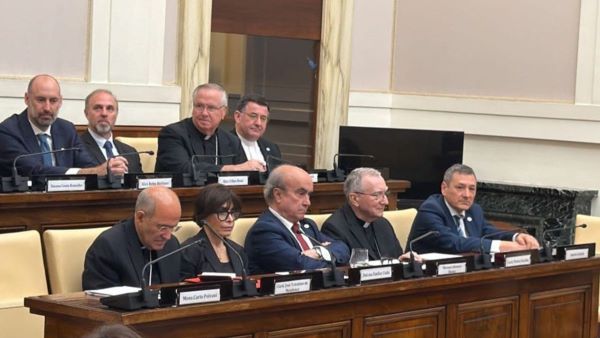 Cardinal Secretary of State Pietro Parolin speaks at a Vatican conference on mental health, digital technologies, and education, lamenting that society offers young people every means available but no purpose.
Cardinal Pietro Parolin and other key speakers at the Conference at the Vatican9;s Casina Pio IV
Describing the mental health crisis affecting young people as “an emergency requiring structural responses,” Cardinal Pietro Parolin warned that today’s society often offers young people “every means but no purpose.”
The Vatican Secretary of State was speaking at the international conference “Maps of Hope for a Regional Educational Agenda: Mental Health, Digital Technologies and Education,” taking place at the Casina Pio IV in the Vatican with education ministers, academics and international experts.
Cardinal Parolin said education remains “a pillar of integral human development, peaceful coexistence and social justice.” He noted, however, that educational systems today face new qualitative challenges, including the integral formation of the person, socio-emotional development, protection of the vulnerable and the responsible integration of digital technologies.
Global Compact on Education
The cardinal reiterated that these challenges cannot be addressed through fragmented measures, but require “structured, multidimensional and long-term cooperation.”
Recalling the Global Compact on Education launched by Pope Francis in 2019, he pointed to Pope Leo XIV’s recent Apostolic Letter on education, which calls for a global “educational constellation” capable of fostering fraternity, peace and justice.
He identified three priorities highlighted by Pope Leo XIV: care for interior life, a “human-centred digital culture,” and education for peace.
Focusing on mental health, Cardinal Parolin said the data concerning young people are “eloquent and, in many ways, alarming,” particularly following the pandemic, which has seen increasing levels of anxiety, depression and psychological distress among adolescents and young adults.
Inseparable unity of body, mind and spirit
The Secretary of State warned against reducing the issue solely to a medical problem delegated to healthcare systems.
“The Church has always taught that the human person is an inseparable unity of body, mind and spirit,” he said, adding that an educational model neglecting any of these dimensions is “incomplete” and incapable of responding to the fullness of human needs.
Instead, he said education must provide young people not only with knowledge and skills, but also with tools to understand themselves, manage emotions, build meaningful relationships and discover purpose in life.
He linked this vision to the Christian tradition’s understanding of the “care of the soul,” now often expressed through the language of socio-emotional competencies and psychological well-being.
Role of schools and families
Cardinal Parolin underlined the essential role of schools and families.
Schools, he said, should be places where every student feels “seen, listened to and accompanied,” while families remain the strongest protective factor for children and adolescents when properly supported.
Digital technologies
Turning to digital technologies, he acknowledged their enormous educational potential, especially in reducing inequalities across large and diverse regions such as Ibero-America.
At the same time, he warned that excessive exposure to digital environments without adequate educational guidance can negatively affect young people’s mental health through attention fragmentation, screen dependency, cyberbullying, social isolation and exposure to harmful content.
“The challenge is not to accept or reject technologies, but to govern them,” he said, calling for digital education that integrates technical competencies with socio-emotional formation.
A “crisis of meaning”
At the heart of the crisis, Cardinal Parolin said, lies a deeper “crisis of meaning.”
Many young people, he observed, feel disoriented not because they lack information or opportunities, but because they lack “a horizon of meaning” within which to understand their lives and hopes.
“A society that offers young people every means but no purpose; every connection but no authentic relationship; every answer but no profound question, is a society that ultimately abandons them,” he said.
The cardinal concluded by urging governments to recognise youth mental health as a priority requiring coordinated investments in education, healthcare, teacher formation and family support.
Echoing the appeal launched by Pope Leo XIV to religion teachers in his apostolic letter to become “choreographers of hope,” he said education must help young people find the tools and horizons needed to live “full, free and meaningful lives.”
Vatican News
Source: vaticannews.va/en