
Commemorating thousands of Polish religious sisters who rescued Jews during WW2
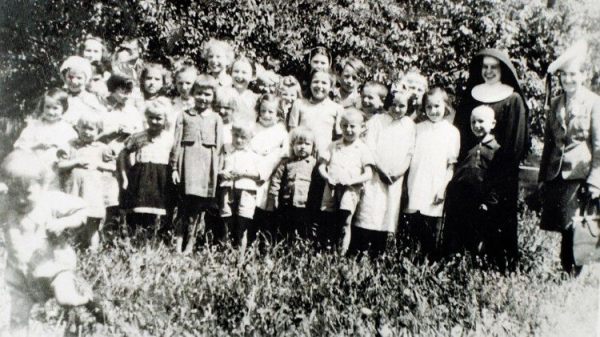 24 March marks the National Day of Remembrance of Poles Who Saved Jews Under German Occupation, linked to the murder of the Ulma family and the Jews they sheltered. Denounced to the Germans, the family was killed on 24 March 1944 in Markowa.
Sister Rozalia Sidełko with a group of children from the orphanage, including Jewish children who were rescued
Despite facing the death penalty, several thousand Polish religious sisters, priests, and other religious sheltered thousands of Jewish children and adults during World War II. In German-occupied Poland, anyone caught hiding Jews risked death by the Nazis. March 24 is the National Day of Remembrance of Poles who rescued Jews under German occupation.
A day of remembrance and its meaning
The date marks 1944 events in Markowa, where German occupiers murdered the Ulma family—Józef, Wiktoria, and their seven children—along with the Jews they hid. This crime is now a powerful symbol of the brutal reprisals faced by those who offered help.
Today’s commemoration has a broader meaning. It honours thousands who, under systemic terror, made choices beyond normal solidarity. These decisions required compassion and a willingness to risk, or even lose, their lives for others.
Religious sisters in the reality of occupation
Despite the constant threat of death, many religious congregations became involved in efforts to rescue the Jewish population.
Religious sisters used convent life as a refuge. Orphanages, boarding schools, and care homes became secret shelters offering some safety. This work demanded courage, skill, discipline, and complete discretion. Any mistake could mean exposure and death.
The witness of the Holy Family Sisters
The Sisters of the Holy Family of Nazareth in Warsaw, at their house on Czerniakowska Street, hid Jewish girls and conducted clandestine education, also banned by the occupying authorities.
The community was led by Sister Eutalia Jadwiga Wismont, who maintained the institution under occupation. Her decisions involved not only accepting those in need but also carefully organising daily life to avoid arousing suspicion.
For her role in rescuing Jews, she was posthumously honoured by Yad Vashem as a Righteous Among the Nations. In 2024, a commemorative plaque was unveiled on the convent building, restoring this history to public memory in the city.
Matylda Getter and a network of support
Extensive rescue efforts were carried out by the Congregation of the Franciscan Sisters of the Family of Mary.
Under the leadership of Mother Matylda Getter, assistance was organised for around 750 people, including more than 500 Jewish children in Warsaw and the surrounding areas.
The sisters created a support network beyond providing shelter. It included securing false identities and offering long-term care—this required coordination between facilities and constant relocation of children when danger arose.
Mother Getter, also recognised as Righteous Among the Nations, remains one of the most important figures symbolising the involvement of religious women in rescuing Jews.
Two thousand religious sisters
The efforts undertaken in Warsaw were part of a broader phenomenon spanning the entire country.
Researchers estimate that more than 2,000 religious sisters from various congregations helped Jews. Their dispersed work is hard to document after the war.
The rescue network they created had no single structure but was based on trust, cooperation, and rapid response to changing circumstances. This enabled hiding individuals who otherwise had little chance of survival.
A lasting testimony
Today’s commemoration goes beyond recalling historical facts, highlighting attitudes forged in extreme circumstances that demanded moral resolve.
The story of these consecrated women shows how love of one’s neighbour takes concrete, often quiet form—revealed most fully in such choices.
How the Polish clergy helped Jews
As part of the work of the Abraham J. Heschel Centre for Catholic–Jewish Relations at the Catholic University of Lublin (KUL), the first English-language monograph on aid provided to Jews during the Holocaust by Polish clergy has been published.
The two-volume publication, “Wartime Rescue of Jews by the Polish Catholic Clergy,” issued by KUL Press and written by attorney Ryszard Tyndorf, is available online as a free download at: https://tiny.pl/s8xxn5vc.
The book spans more than 1,200 pages and consists largely of testimonies from Jews rescued by religious sisters and priests in Poland during the Holocaust. It also includes an index listing thousands of places and the names of both rescuers and those who were saved.
Vatican News
Source: vaticannews.va/en