
DAILY MEDITATION: “Whoever exalts himself will be humbled;....”
Liturgical day: Saturday of the Twentieth Week in Ordinary Time
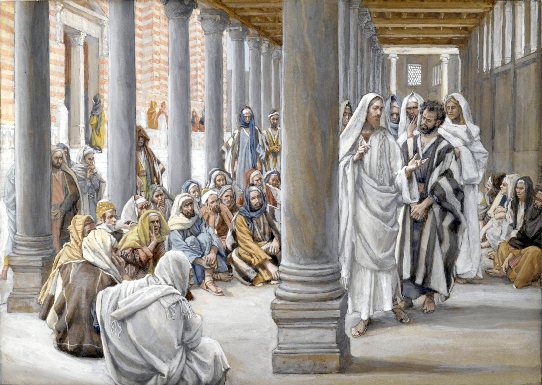 Gospel text (Mt 23,1-12): Jesus spoke to the crowds and to his disciples, saying, “The scribes and the Pharisees have taken their seat on the chair of Moses. Therefore, do and observe all things whatsoever they tell you, but do not follow their example. For they preach but they do not practice. They tie up heavy burdens hard to carry and lay them on people’s shoulders, but they will not lift a finger to move them. All their works are performed to be seen. They widen their phylacteries and lengthen their tassels. They love places of honor at banquets, seats of honor in synagogues, greetings in marketplaces, and the salutation ‘Rabbi.’
As for you, do not be called ‘Rabbi.’ You have but one teacher, and you are all brothers. Call no one on earth your father; you have but one Father in heaven. Do not be called ‘Master’; you have but one master, the Christ. The greatest among you must be your servant. Whoever exalts himself will be humbled; but whoever humbles himself will be exalted.”
“Whoever exalts himself will be humbled; but whoever humbles himself will be exalted.”
Fr. Antoni CAROL i Hostench
(Sant Cugat del Vallès, Barcelona, Spain)
Today, Jesus Christ once again calls us to humility, an invitation to place ourselves in our true place: “Do not be called ‘Rabbi’ (...); call no one on earth your Father (...); do not be called ‘Master” (Mt 23,8-10). Before we claim all these titles, let us give thanks to God for all that we have which we have received from Him.
As Saint Paul says, “What do you possess that you have not received? But if you have received it, why are you boasting as if you did not receive it?” (1 Cor 4, 7). So, when we realize that we have acted correctly, we will do well to repeat: “We are unprofitable servants; we have done what we were obliged to do” (Lk 17, 10).
Modern man suffers from a regrettable amnesia: we live and act as if we ourselves were the authors of life and the creators of the world. By contrast, Aristotle is admirable. In his natural theology, he was unaware of the concept of 'creation' (a notion known at that time only through divine Revelation) but at least understood that this world depended on Divinity (the 'uncaused Cause'). Saint John Paul II calls us to preserve the memory of the debt we owe our God: 'Man must honor the Creator by offering, in thanksgiving and praise, all that he has received from him. Man cannot lose the sense of this debt, which he alone, among all other earthly realities, can recognize.'
Furthermore, considering the supernatural life, our collaboration—He will do nothing without our permission, without our effort! —consists in not hindering the work of the Holy Spirit: letting God act! Holiness is not 'made' by us, but bestowed by Him, who is Master, Father, and Guide. In any case, if we believe that we are and have something, let us strive to put it at the service of others: 'The greatest among you must be your servant' (Mt 23, 11).
Source: evangeli.net