
DR Congo: Comboni Missionary Sisters make common cause with most vulnerable
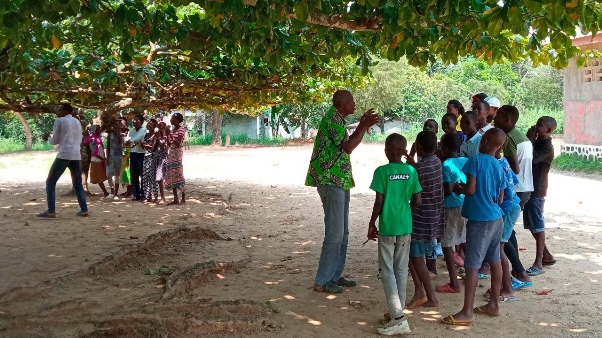 The Sisters of the Comboni Missionaries Postulancy share their lives with Kisangani9;s street children, in the Democratic Republic of Congo, offering their services at the Saint Laurent Centre, which is not merely a refuge, but a chance for a better future.
The yard at the Saint Laurent Centre, Kisangani, DRC. Photo: Sr. Francisca Sanchez, CMS
There are children in the Democratic Republic of the Congo who have been orphaned and scarred by violence. They are in need of affection, closeness and someone who, through their gaze and smile, can convey the following message to them: “You are important to me.”
The Saint Laurent Centre in Kisangani, DRC, aims to welcome and accompany these children on a journey to help them feel comfortable with themselves and with others.
The Sisters of the Comboni Missionaries Postulancy are always present, in particular Spanish Sr. Francisca Sánchez, who has extensive missionary experience in the Democratic Republic of the Congo and Togo, and Sr. Nicole Mboma Enzenze, a Congolese sister with experience in Mozambique.
With the assistance of five postulants from Chad and the Democratic Republic of the Congo, they accompany the children in their various activities.
History and mission
The Saint Laurent Centre was founded on 10 August 1999, by Dehonian missionary, Father Giovanni Pross, in response to the aftermath of the war that severely affected Kisangani in 1996 and 1997. Comboni Missionary Sisters have been working alongside him from the very beginning.
The centre is organised into different areas: school, formation, hygiene and health, kitchen, support and personal care. Everyone works together, and a meeting with volunteers and staff members is held every Saturday to organise the work agenda. Children in care are divided into three groups (younger, middle and older). Each group has a supervising adult who is always present, day and night.
The work is not easy, and the initial approach requires patience and great sensitivity in responding to the needs of children who have experienced profound trauma, particularly resulting from abandonment.
At the same time, firmness is necessary to ensure that the lack of clear reference points does not compromise the effectiveness of the educational system.
“At first, many children are violent and struggle to follow the rules, so it is necessary to be firm, but at the same time, one must act with tenderness,” explains Sr. Nicole, who has been working at the centre since early 2024 as head of the depositary for clothes, shoes, and school supplies.
Sr. Francisca, who has been working at Saint Laurent since 2021, is responsible for the residents’ personal and intellectual development, including through educational films, as well as for the liturgical and musical aspects of the centre.
She oversees a choir that has also proven to be therapeutic in cases of trauma. Paulina’s story is a good example of this. She lost the ability to speak after suffering from a severe trauma. Thanks to singing in the choir, she is now able to sound out her name in syllables. It is a tremendous success for everyone.
Stories of life and rebirth
Many of the stories of the children in our care make a deep impression. One example is the story of a four-year-old boy, found in the forest after a long period of isolation. He had serious difficulties forming relationships and communicating.
Thanks to the constant and loving care of the nuns and carers, he slowly began to trust again, to speak, and to share his emotions. Starting nursery school further helped his development, turning what were initially difficult relationships into harmonious bonds.
Sr. Nicole recalls that their first encounter was difficult. After she was forced to reprimand him, the boy stopped speaking to her for a week. It was she who took the first step, approaching him with a smile and kind words. These small gestures of closeness melted his initial mistrust away, and today, the sister says, “We are great friends.”
“Every time he sees me coming, he runs towards me to give me a hug and tell me about everything he did and learned at school,” she says.
Sister Francisca has a story that marked her profoundly. She recalls a seven-year-old girl with a foot deformity, who was taken to Goma for an operation to get her back on her feet. When she returned to Kisangani, she was taken in by a foster family.
The girl went to visit the sisters and asked if she could work by putting to use the practical skills she had learned at the centre, in order to help her foster mother pay for her school fees. The girl’s initiative deeply moved the nuns and became a tangible sign of how a journey of growth is possible when one feels welcomed, listened to and valued.
A life-changing experience
The postulants provide vital support in the library and with schoolwork. They say that seeing even the smallest progress in a child who is learning to read, can turn a bad day around.
Some find that, when they are feeling tired, simply spending time with a child is enough to fill their hearts with renewed energy. All the postulants describe the library as a meeting place where children are not afraid to ask for help, where they can be listened to and can hear words of comfort.
If their founder, Saint Daniele Comboni, were alive today, the sisters say, he would be there alongside these children. He himself showed special care for little ones, the abandoned, and the least in society, because every child welcomed today is a chance for peace tomorrow.
Sr. Loreta Beccia — Yaoundé
Source: vaticannews.va/en