
Fr. Patton: Prayer and fasting are only weapons Christians should use
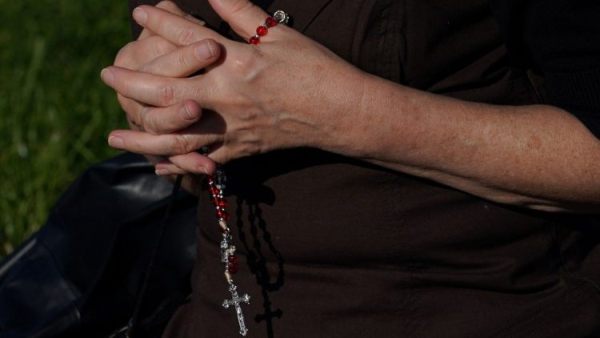 Speaking from Jordan, the former Custos of the Holy Land makes an appeal for a “great gathering for all” in the name of peace and an end to violence in the Middle East, stressing that the only weapons Christians should use are 'prayer and fasting.'
The former Custos of the Holy Land appeals for peace through fasting, prayer, and dialogue
“We are gripped by a kind of war madness, the idea that everything can be resolved through force and weapons. The thought of civilian victims is constant and deeply present,” lamented Fr. Francesco Patton, former Custos of the Holy Land.
Speaking from Mount Nebo in Jordan, his gaze turned beyond the Dead Sea that separates the Hashemite Kingdom from Israel and Palestine, his thoughts fixed on a Middle East in flames.
“Every day I think of my fellow friars living in Lebanon, in Beirut and elsewhere, both in the south and the north, who are being tested beyond measure,” Fr. Patton explained. “The convent in Tyre has been turned into a refugee camp, and those in Beirut are desperately trying to help the civilian population, who simply cannot go on—there are now one million displaced people out of a total population of six million.”
What comes after the war?
The former Custos recalled that from the very beginning of the war in Gaza it was clear—especially to people like him with years of experience in the region—that unless the conflict was brought to an end “in a nonviolent way, it would spread.”
But the danger, he warned, is that no one knows what will happen at the end of the war.
Following “all the recent Middle Eastern wars, new forms of terrorism have emerged and new groups have arisen, such as Al-Qaeda, ISIS, Hezbollah, and Hamas—each born in the wake of conflicts that were not resolved politically, all the result of attempts at military solutions to conflicts that should have been addressed differently.”
The tragedy of Palestine
Fr. Patton then turned to Gaza, echoing remarks made a few days earlier by the Latin Patriarch of Jerusalem, Cardinal Pierbattista Pizzaballa.
He stressed that the Strip is devastated, that people are living practically in an open-air sewer, and that beyond the extreme hunger there remain “the problems of medicines, of security, of a life lived with respect for fundamental rights and human dignity. On top of that, there is this so-called Peace Board, which has not even begun to function and seems more like a ghost than an operational reality.”
Meanwhile, in the West Bank, the expansion of Israeli settlements continues, with tens of thousands displaced. “The occupation continues, and so do acts of violence,” Fr. Patton added, recalling “the family killed a few days ago in the Nablus area, with a nine-year-old child as the sole survivor.”
There are also ongoing “legislative initiatives that prevent the West Bank from existing and Palestinians from having their own land and the protection of fundamental rights, such as registering Palestinian territories in the Israeli land registry or refusing to allow teachers with degrees from Palestinian universities to teach in Israeli schools.”
All of these are “forms of direct or indirect pressure aimed at expelling the Palestinian population from the land on which they have lived for millennia.”
The severe economic crisis caused by the war is also being felt strongly in Jordan due to the collapse of pilgrimages.
“At the end of February, we were seeing a certain recovery in the number of visitors and pilgrims, and suddenly we have fallen back to practically zero,” the former Custos highlighted. This affects especially—but not only—Christians who work in the holy places and are now left without jobs or means of support for their families.
The only weapons for Christians
For this violence to end, Fr. Patton believes the international community must act more decisively and that there must be “a change in US policy toward the Middle East.”
From the Church9;s perspective, he said, there is also hope for “a great gathering, addressed to Christians and believers of all religions, as Pope John Paul II did during the Iraq war and as Pope Francis did in 2013—a great gathering for all for fasting and prayer for peace.”
“It is a tool that may seem ridiculous compared to weapons,” he concluded, “but it is a means of raising awareness that can unite believers of different religions,” in line with what Pope Leo XIV describes as a “disarmed and disarming peace, humble and persevering.”
For believers, Fr. Patton concluded, “prayer and fasting are the only ‘weapons’ we are permitted to take up.”
Francesca Sabatinelli
Source: vaticannews.va/en