
In the footsteps of St. Rita: A Brazilian woman on mission in Italy
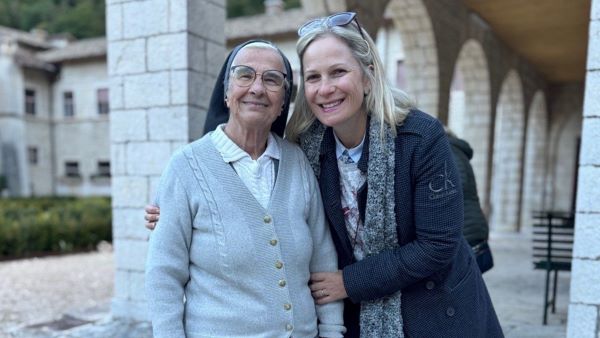 Sister Maria Atília Collet has found in the saint of impossible causes a guiding light for her own life and that of thousands of pilgrims. Before arriving in Roccaporena, the Italian town where Saint Rita was born in 1381, her religious mission took her from inland Brazil to Italy, Portugal, Spain and Mozambique. She spent over 15 years in the African country, where she deepened the human and spiritual experience that today guides her in welcoming pilgrims.
Sister Maria Atília and the journalist, Andressa, in Roccaporena, Italy
The ties that bind the beginning of this story cross two nations, a single family and a devotion to Saint Rita of Cascia. This article, too, stems from this connection, written by the daughter of the late Rita Collet, a second cousin of Sister Maria Atília Collet. All of us were born in Brazil, but today two of us live in Italy, where our family history finds its spiritual fulfilment.
This journey across generations and regions leads to Umbria, in central Italy. There lies Roccaporena, a small town about six kilometres from Cascia, a town closely linked to the life of Saint Rita. Today, Roccaporena is where Sister Maria Atília lives.
As a member of the International Consolata Family, she dedicates her days to welcoming pilgrims who travel there seeking prayers and the graces attributed to the Saint of Impossible Causes. Since moving to the region about a year ago, Sister Maria Atília has included a special personal devotion in her daily life. Every day she prays for my mother.
“This is where I pray for your mother,” she said. “From the day I arrived here, I open the door at 5:30 in the morning, and praying for your mother comes naturally.”
The religious sister was referring to the Church of San Montano in Roccaporena. It was here that Saint Rita of Cascia (1381-1457) was formed in her faith and received her First Communion, Confirmation and Marriage. The churchyard also serves as the final resting place for the saint’s family and the town’s early inhabitants, safeguarding the historical memory of the town’s original community.
Today, the Church welcomes pilgrims from all over the world, who come to pray and entrust their intentions—considered impossible—to the saint. In this setting, Sister Maria Atília serves as a living bridge between modern-day devotees and the early life of Saint Rita, whose Christian upbringing was shaped in Roccaporena itself.
“Every Sunday, the saint came here to join in communal prayer,” the sister said. “This is where she lived her Christian life to the fullest. This is where she learned to pray, to forgive, and to ask God for the grace of forgiveness and conversion for her husband. She also prayed for local peace. At the time, the town was torn apart by two rival factions fighting for power, a feud that escalated into bloodshed.'
Spiritual and geographical journey to Roccaporena
Today, walking the streets of Roccaporena, the Brazilian religious Sister seeks to bring the saint’s legacy to life, turning a story of suffering and forgiveness into a tangible experience for pilgrims.
In the house where Rita was born, visitors can catch glimpses of her childhood and simple lifestyle, for instance, in the small room where she was born, and through a blanket she would use during winter, when local temperatures could drop to 20 degrees below zero. Although the fabric deteriorated over time, the blanket was faithfully reconstructed using leather fragments from the original one.
Sister Maria Atília also guides visitors through the home where Rita lived as a wife, mother, and widow before entering the convent, illustrating the family dynamics and the profound grief she endured. From there, the saint would climb the mountain to pray at the Rock of Prayer, a peak that pilgrims still visit today, climbing the 314 steps to an altitude of 827 meters.
“She prayed deeply for the conversion of her husband, who was a notorious criminal,” the sister explained. “Rita would leave her house and climb the mountain to a large white stone, a place of prayer not just for her, but for many pilgrims. Even back then, it was a place of rest and contemplation.”
Today, that family home has become a “house of prayer,” a chapel open to the public where young couples about to marry often gather, as the sister recounted.
“The interesting thing is that even today, this house welcomes young people who come to spend nights in prayer on the eve of their wedding,” she said. “For me, this is incredibly powerful. I always think of Rita, here with her children, while her husband would plan a crime. And she would pray for God to touch his heart. Or I think of Rita raising her children with the affection of a mother who wants only the best for them, passing down values that her husband lacked. We don9;t know if she climbed the mountain during winter, but she certainly went during the day, because at night it would have been impossible. Up there, she felt closer to God. She is a truly great woman, a very special saint.”
Visiting the small Umbrian town, with its traditional stone houses and alpine landscape, also includes the “Lazzaretto,” which recalls Rita’s charity towards the sick; the Miracle Orchard, famous for the miracle of the rose and figs that appeared in mid-winter; and the Augustinian Sanctuary of Saint Rita, Roccaporena’s spiritual hub.
A legacy of prayer and forgiveness
With Sister Maria Atília, pilgrims do not only visit Roccaporena; they retrace the very life of Saint Rita and the values that guided her: prayer and forgiveness as a path to understanding God’s greatness. “Saint Rita9;s life is profoundly moving. She lived a life of prayer, close to the crucifix,” the sister explained, revealing the deepest source of the saint9;s actions.
It is precisely in this woman of prayer that the Brazilian missionary found a reflection of her own life. Long before guiding pilgrims in Roccaporena, she had walked other mission paths, crossing geographical and cultural borders.
She worked in Brazil, Italy, Portugal, Spain, and Mozambique. She spent over 15 years in the African nation—between Pemba, in the Cabo Delgado province, and Maputo. Today, at age 81, she brings that enriching experience to her mission of welcoming pilgrims and listening to their prayers and gratitude.
“They asked me if I was available to come here. I have never chosen my destinations,” she said. “And today, I feel truly happy. People who meet me tell me that I radiate happiness, so I must thank God. It is a blessing for me, but also for every pilgrim who arrives here, because they leave with an inner peace and a different outlook on life.”
Andressa Collet
Source: vaticannews.va/en