
'Intensive Week' of Dicastery for Promoting Integral Human Development
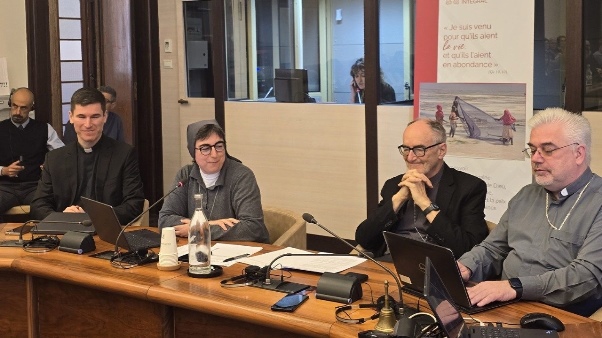 Employees, collaborators, volunteers, and interns of the Dicastery for Promoting Integral Human Development, including those working abroad, meet in Rome for a week of sharing and proposing initiatives, with Cardinal Prefect Michael Czerny saying the goal is 'to support the mission of the Pope and the Bishops throughout the world.'
The “Intensive Week” of the Dicastery for Promoting Integral Human Development
Employees, collaborators, volunteers, and interns of the Dicastery for Promoting Integral Human Development gathered for an 'Intensive Week' of sharing and proposing initiatives from April 23 to 30, mainly at the Dicastery9;s headquarters at the Palazzo San Calisto, in Rome.
Various activities were organized for everyone, including colleagues from the so-called “diaspora,” who are collaborators working outside Rome. These included visits to the Vatican Museums, the Borgo Laudato Si’, and participation in Pope Leo XIV’s Regina Caeli prayer in St. Peter’s Square.
Listening rather than imposing themes
The tradition of the “Intensive Week” began in 2023 and has continued regularly in the following years. In an interview with Vatican News, Cardinal Michael Czerny, Prefect of the Dicastery for Promoting Integral Human Development, identified three principal goals: re-reading the mission of the Dicastery in the present moment; strengthening internal communication to foster efficient functioning; and reinforcing relationships between those working at headquarters and those in the diaspora, enriching the quality of the Dicastery’s service.
Regarding the themes discussed, the Cardinal Prefect referred to what he called a “dogma”: the Dicastery does not establish priorities from above, but instead listens to local Churches and accompanies them in their mission of addressing what hinders integral human development in their particular contexts.
Echoing this perspective, Sr. Alessandra Smerilli, Secretary of the Dicastery, described the week as a time to interrupt the daily routine and “restore energy.” The key word she proposed as a guiding compass was “knowledge.”
Undersecretary Monsignor Jozef Barlaš, who succeeded Monsignor Anthony Onyemuche Ekpo in November 2025 after the latter was appointed Assessor for General Affairs of the Secretariat of State, emphasized that the diaspora is not merely a logistical matter, but rather an image of a Church present in every corner of the world.
On a five-day pastoral visit to Bangladesh, Cardinal Michael Czerny visits Cox’s Bazar, which houses more than one million people, mostly Rohingya refugees from Myanmar.
9;Helping the Pope and the Bishops9;
The opening assembly, held in the Văn Thuận Hall, took place in a warm and lively atmosphere marked by a great diversity of origins, ages, languages, and roles.
Cardinal Czerny concluded the session by expressing gratitude for all the sections and areas of the Dicastery: Listening and Dialogue, Research and Reflection, Communication and Outreach, Secretariat and Services, and Administration and Planning.
Among the formation sessions was one on ongoing accompaniment processes, led by Cardinal Undersecretary Fabio Baggio. The guiding principle, reiterated by the Cardinal, was clear: the goal is not to organize events, but to accompany processes and support initiatives. These are paths aimed at concrete pastoral results and capable of leaving lasting marks within local Churches.
Among the external speakers was Dr. Pasquale Ferrara, Secretary General of the European University Institute in Florence, who offered several interpretive keys regarding a world order undermined by numerous conflicts and by the play of economic interests.
Examining internal communication
Throughout the week, the entire Dicastery staff had the opportunity to discuss new strategies for improving internal communication, continuing a project launched in 2024.
Introducing the session, Sr. Smerilli stressed the importance of effective relationships in carrying out daily work.
The heart of the meeting was a practical exercise. Participants divided into seven groups, and worked on issues that had emerged during the process, ranging from the effectiveness of meetings to collaboration between offices and the management of information flows. They then presented observations and operational proposals.
Day at Borgo Laudato Si’
The activities of April 28 took place in Castel Gandolfo at the Borgo Laudato Si’. The day began with the celebration of the Eucharist using the new formulary “pro custodia creationis,' presided over by Archbishop Vittorio Francesco Viola, Secretary of the Dicastery for Divine Worship and the Discipline of the Sacraments, at the altar in the garden near the statue of the Madonna.
This was followed by an update from Cardinal Baggio on the development of the Laudato Si9; Centre for Higher Education.
Cardinal Czerny offered a meditation based on the document of Synod Study Group 2, “To Hear the Cry of the Poor and the Earth.' The importance of considering the poor as active subject, protagonists rather than passive recipients, emerged strongly. In the afternoon, a team-building session guided by an expert took place.
Final encouragements
In the concluding assembly, Cardinal Czerny urged participants to remain attentive and supportive in the face of disasters affecting different regions of the world, while anticipating new forms of collaboration with the Dicastery for the Service of Charity.
He also recalled a passage from Pope Leo XIV’s address at the Catholic University of Central Africa during the Apostolic Journey to Cameroon: “No society, in fact, can flourish unless it is grounded in upright consciences.'
From this perspective proposed by the Holy Father, the Cardinal observed, the daily work of the Dicastery is reflected as both an encouragement and a challenge in pastoral service and accompaniment.
In a digital world in which everything can be said and thought, “upright consciences” and “holy restlessness” point to a solid foundation for the common journey toward integral human development. In other words, the goal is to promote 'life in abundance,” as promised by Jesus.
Edoardo Giribaldi