
Rosaries made by cloistered nuns to accompany Pope in Spain
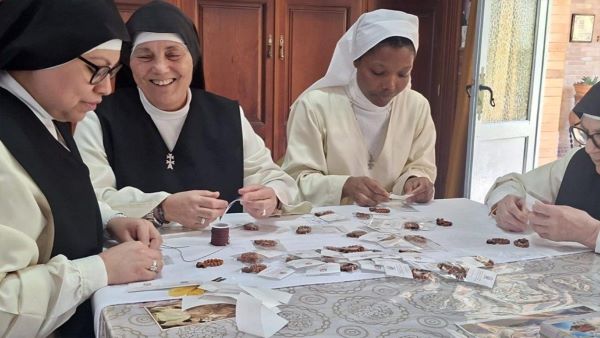 Ten contemplative monasteries are preparing thousands of rosaries for Pope Leo XIV’s apostolic visit to Spain. The small hand-crafted objects are born of silence, prayer, manual labour, and the help of young volunteers.
Cloistered nuns in Spain handcrafting rosaries for the Pope9;s apostolic visit
An invisible thread, woven of hope, wooden beads, and work-worn hands, is silently making its way through Spain these days. Its beginning is in the cloistered monasteries scattered across Castile, Navarre, Catalonia, and Andalusia, and it reaches all the way to the crowds of pilgrims awaiting Pope Leo XIV.
It is the thread of rosaries: small pocket-sized treasures fashioned in the silence of the cloisters, and becoming one of the most meaningful symbols to accompany the Pope’s visit.
Behind every bead lies a hidden life, a low and humble voice, a labour of love that will never appear in official schedules or televised images. Yet it is in those cloisters that one may catch a glimpse of a world that Spain once knew intimately and now seems almost to have forgotten.
“In our country, there are more than seven hundred monasteries. We are one of the great monastic realities in the world,” explains Alejandro Simón of Fundación Contemplare, the network that for years has helped contemplative communities sustain themselves through artisanal work and, above all, through the spiritual bond they establish with those who visit them or discover the hidden beauty found beyond the doors of a monastery.
Participating in the Pope’s pilgrimage
The monasteries are not isolated from the world. Rather, they exist outside the dominant logic of haste and noise. They remain at the margins of political and social clamour. And yet, paradoxically, through the preparations for the Pope’s visit, they have suddenly regained attention.
The idea of the rosaries was born almost naturally: a simple and humble object capable of accompanying the visit of Pope Leo XIV. Fundación Contemplare began contacting monasteries throughout the country to ask whether it would be possible to produce several thousand rosaries in just a few weeks.
The answer was immediate.
“They all said yes,” Simón says. “Not because of the scale of the request, which is enormous for communities with very few members, but because they understood that this was a way to participate in the pilgrimage of the Pope.”
Since then, the rhythm of work inside the monasteries has changed. In the wax and wood-scented workshops, in the sewing rooms and small artisan studios, monks and nuns have multiplied their hours of labour. Some assemble the beads one by one; others prepare the crosses or small cloth bags in which the rosaries will be distributed.
The contribution of volunteers
In many monasteries, young volunteers have also arrived to help. University students, families, and parish groups have crossed the thresholds of cloistered convents to collaborate in silence with the religious communities. For many of them, it has become their first direct encounter with contemplative life.
“They discover a world they did not know,” Simón explains. “A world where time has another rhythm, where work is done without anxiety, and where silence is not emptiness but presence.”
The rosaries are not luxury items. Most are made of simple wood, cord, and small metal crucifixes. Yet it is in that simplicity that their value lies. Each one bears with it the time it took to realise it, prayer, and the hidden sacrifice of the person who made it.
For the contemplative communities, the Pope’s visit has become more than a national event. It is an opportunity to remind society that cloistered life continues to exist, often silently, discreetly, and with difficulty, but it is still alive.
Many monasteries in Spain deal with the issues that come with ageing communities, economic hardship, and a lack of vocations. Some have had to close in recent years. Others survive thanks to the sale of sweets, embroidery, icons, soaps, or other handcrafted products.
A network of prayer
And yet, despite their fragility, these monasteries continue to sustain an invisible network of prayer that many believers still consider essential.
“There are people who ask us constantly for prayers,” Simón says. “For illnesses, family situations, unemployment, loneliness. The monasteries carry an enormous spiritual burden that often remains unseen.”
For this reason, the rosaries prepared for the papal visit are more than simple devotional objects. They are also a sign of the hidden presence of contemplative life in the Church and in society.
In the coming days, thousands of pilgrims will receive one of these rosaries in their hands. Few will know where it came from. Few will imagine the silence of the cloister, the patient labour of elderly hands, or the quiet conversations that accompanied its creation.
But in each rosary there will remain something of that hidden world: the prayer of monasteries that, from behind their walls, continue to accompany the journey of the Church.
Silvina Pérez