
Synod releases Reports on poverty and the environment, and on polygamy
 The General Secretariat of the Synod publishes the Final Reports of Study Group No. 2, 9;To hear the cry of the poor and the earth,9; and that of the Symposium of Episcopal Conferences of Africa and Madagascar (SECAM) Commission on 9;the pastoral challenge of polygamy.9;
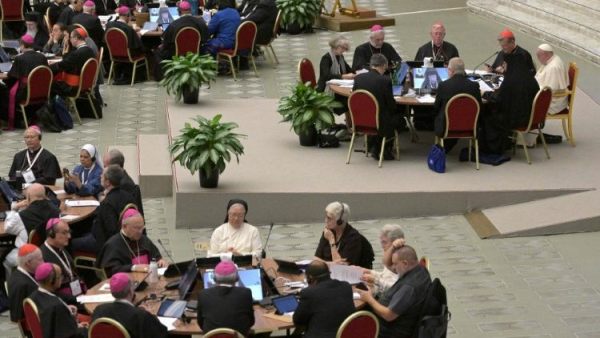
File photo of the Synod on Synodality
The General Secretariat of the Synod today published the Final Report of Study Group No. 2 on 'To hear the cry of the poor and the earth,' and that of the Symposium of Episcopal Conferences of Africa and Madagascar (SECAM) Commission on 'The pastoral challenge of polygamy.'
Both Reports, in their thematic diversity, bear witness to the synodal journey of the Church: a Church that listens, discerns, accompanies, and, rooted in the Gospel, never ceases to draw near to every man and woman, responding to the challenges of our time.
The Final Reports and a brief summary in five languages are available on the website of the General Secretariat of the Synod: www.synod.va.
Pope Leo XIV has directed the publication of these Final Reports to share with the entire People of God the fruits of the reflection and discernment undertaken during the Synod, in a spirit of transparency and accountability. These are considered working documents. With the submission of the Final Reports to the General Secretariat of the Synod, the Study Groups that have delivered it conclude the mandate entrusted to them and are therefore to be considered dissolved.
Final Report of Study Group No. 2
The Final Report of Study Group No. 2 on 'To hear the cry of the poor and the earth' is developed across several sections.
Preceded by a reflection from Cardinal Michael Czerny, Prefect of the Dicastery for Promoting Integral Human Development, the Report seeks to respond to the five fundamental questions entrusted to the Group regarding how the Church can better hear the cry of the poor and of the earth.
The document proceeds from the theological conviction that listening to the poor and to the earth is not a pastoral option, but an act of faith constitutive of the Church’s mission, rooted in the twofold commandment of love and in the example of the Good Samaritan. As Cardinal Czerny recalls in his preface, the term “listening” denotes an integral process that includes encounter, understanding of the problem, action, evaluation, and spiritual support, and concerns every Christian, including those who themselves feel poor.
The guiding question of the Group’s work thus becomes: how can the Church better listen to these two interconnected cries, aware that responding to the cry of the poor also means responding to the cry of the earth, and vice versa?
The Report outlines the working methods adopted, the limitations encountered, and the lessons learned.
It identifies the tools already present within the Church, including parishes, basic communities, movements, Caritas bodies, ecumenical and international networks, and highlights their richness, while at the same time calling for the overcoming of the temptation to delegate improperly to specialized structures, recalling every baptized person to co-responsibility.
Among the concrete proposals is the establishment of an Ecclesial Observatory on Disability, suggested by a subgroup composed largely of persons with disabilities, as a model that can be replicated at local and regional levels to give voice to all marginalized groups.
On the theological level, the Report underscores the need for a theology that arises from listening to the poor and to the earth as authentic theological loci, and calls for theologians from the most vulnerable communities to be actively involved in the drafting of magisterial documents. Particular attention is given to formation, considering training programmes for laity, religious, and seminarians, noting that they must integrate direct encounter with existential peripheries, competence in listening as a spiritual discipline, not merely as a technique and social analysis.
The Report concludes with a vision of a synodal Church capable of becoming itself an instrument of listening, not merely possessing structures for listening, but transforming each of its members into a missionary presence alongside the most vulnerable.
History of SECAM Commission on polygamy
The SECAM Commission focusing on the challenge of polygamy came to be in response to the request from the First Session of the 16th Ordinary General Assembly of the Synod of Bishops Assembly in October 2023, which encouraged SECAM to promote theological and pastoral discernment regarding polygamy and to accompany persons in polygamous unions who are coming to faith. Accordingly, the Church in Africa, through its continental body, SECAM, established a dedicated Team of Experts.
The Team of Experts, comprising 12 specialists from various regions of Africa and its islands and representing diverse fields such as dogmatic and fundamental theology, biblical studies, pastoral care, canon law, and anthropology, convened in person and virtually.
The draft document was shared with the Dicastery for the Doctrine of the Faith via the General Secretariat of the Synod. SECAM received encouraging feedback from the Dicastery, along with specific considerations to be addressed and the text was returned to the Team of Experts for further refinement. The interim text was presented and discussed by Bishops and theologians during the SECAM Plenary Assembly, held in Kigali, Rwanda, from 30 July to 4 August 2025. The insights from this assembly informed the final version of the document.
Following the deliberations at the Plenary, the final text was submitted to the General Secretariat of the Synod and the Dicastery for the Doctrine of the Faith for further guidance and the Final Report was published today.
Overview of SECAM Report
SECAM, hence, has developed an organic reflection on the pastoral challenge of polygamy, rooted in the cultural, anthropological, and theological context of the African continent.
The Report begins with the recognition of the sacred value of the African family, founded upon the covenant among human groups, with the ancestors, and with God, in which the child is considered a divine blessing and the desire for numerous offspring forms an integral part of communal identity. It is within this horizon that the historical existence of polygamy is situated, a phenomenon not exclusive to Africa but particularly rooted there and pastorally urgent.
The biblical analysis reveals its ambivalence: tolerated in the Old Testament, it is progressively surpassed by the New Testament revelation, in which Jesus, recalling the original plan of the Creator, clearly affirms the unity and indissolubility of marriage.
The document firmly reiterates the Church’s teaching: Christian marriage is monogamous by theological nature and not by cultural imposition.
On the pastoral level, SECAM excludes any form of recognition of polygamy and recommends that polygamous catechumens not be admitted to baptism before freely embracing the commitment to monogamous marriage. This is not a matter of exclusion or stigmatization, but of patient and respectful accompaniment, inspired by the mercy of Christ.
The dignity of women is placed at the center of this pastoral approach, with Mary, the Mother of Jesus, offered as a model of evangelization incarnated within culture. The conclusion opens toward a “pastoral care of proximity” capable of opening the doors of the Church to those living on spiritual and existential peripheries, recognizing in every person a child of God called to faithful love and to the Covenant.
Polygamy report conclusion
The Report concludes, acknowledging that polygamy continues to be a reality in African societies today, but its existence and spread vary according to the policies of each state, the predominant religion, and traditional cultural influence.
'In this context, the proclamation of the Gospel and its proposal to adhere to a monogamous marriage relationship sometimes encounters certain resistance justified by cultural reasons.
They acknowledge that throughout the history of evangelization, there have been attempts to admit people living in polygamous relationships into the Christian community that have had different models, sometimes varying from one diocese to another, from one episcopal conference to another, yet within the same sociocultural space.
'At a time when the Church intends to live fully its synodal character, in the communion and participation of all, it becomes urgent for the Church in Africa,' the report states, 'to share these models and to evaluate them doctrinally and pastorally, and, where appropriate, to propose other paths, with the aim of offering to all the possibility of an encounter with Christ and his Gospel.'
The pastoral action of the Church in Africa in accompanying polygamous couples, which asks to be welcomed into the Church, appears as an attempt to be faithful to the Church’s understanding of marriage and that of a Christian family.
'The need to welcome and accompany individuals and families is becoming increasingly evident,' the African Bishops underscore, 'so that they can respond more clearly to the call made to them by the truth revealed by the Gospel on the vocation and mission of the family in the Church and in society.'
'Hence,' they conclude, is 'the urgency of having a pastoral approach of proximity and attention to help understand the sacrament of marriage not as a social convention, but as a gift for the sanctification and salvation of spouses,' noting, 'As a vocation and mission, it is received as a gift.'
Vatican News
Source: vaticannews.va/en