
The Pope’s Almoner: The poor are our compass for walking in the Church
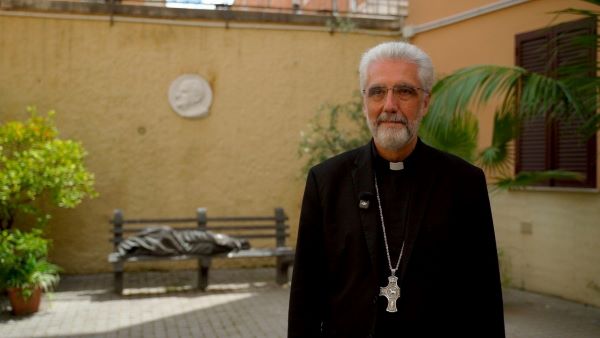 Archbishop Luis Marín de San Martín speaks to Vatican News about his first two months as Prefect of the Dicastery for the Service of Charity.
Archbishop Luis Marín de San Martín, Prefect of the Dicastery for the Service of Charity.
There is always a queue at the Apostolic Almonry, the Pope’s office dedicated to charity, located near the Vatican’s Sant’Anna Gate, just a few meters away from St. Peter’s Square.
The courtyard is decorated with flowers and the sculpture ‘Homeless Jesus’ by Canadian artist Timothy Schmalz. It depicts a poor man sleeping on a bench, with the wounds of the Crucifixion visible on his feet, revealing his identity.
There is constant movement around the “House of Zacchaeus,” as the place is informally called, which faces the entrance of the Dicastery for the Service of Charity (the Apostolic Almonry).
Here, from Monday to Saturday, several deacons welcome people and listen to their requests. The queues at the Almonry’s counters are especially long during May, when many celebrate their First Communion. People wait to fill out forms requesting an apostolic blessing to commemorate important moments in life, such as anniversaries, baptisms, or weddings.
For the past two months, these rooms have also been home to the Augustinian Archbishop Luis Marín de San Martín, whom Pope Leo appointed Prefect of the Dicastery for the Service of Charity on March 12.
Q: Two months ago, Pope Leo chose you to lead the Dicastery for the Service of Charity. What do you remember about that moment?
Certainly emotion, but above all, I would say joy. Joy because this role puts me in direct contact with the Gospel and with concrete charity; it makes me a pastor, I am a bishop, therefore a minister, a servant.
I would also say a deep sense of gratitude for the trust the Pope placed in me by appointing me to such a great and important Dicastery, one so open to every kind of need.
In these two months, I have also developed a growing sense of responsibility in wanting to give my very best in directly serving the poor. They are the center, the point of reference.
I remain entirely available to the Holy Father and to the Church, because this is my life and my ministry: to serve. Here I can truly serve the Church through the poorest and most needy.
Q: The Apostolic Almonry has often been described as the “emergency room of charity.” The Dicastery has many different dimensions…
Yes. Since Praedicate Evangelium, the Almonry has become a Dicastery — the Dicastery for the Service of Charity. It is enormous and very broad in scope.
The best-known area is the one dedicated to apostolic blessings: a small gift that directly benefits the poorest. Those who request a blessing contribute to the service of charity.
Then there is the medical and healthcare area, with two clinics in St. Peter’s Square dedicated to the needy, often people without documents. It is staffed by 120 volunteer doctors and equipped to provide specialized diagnostic exams for the poor.
There is also the hygiene and sanitation area, including the showers in St. Peter’s Square, as well as hospitality services at the Domus Mariae, run by the Missionaries of Charity; Palazzo Migliori, managed by the Community of Sant’Egidio; and a shelter.
Everything revolves around caring for the most fragile by offering healthcare, meals, hygiene services, and shelter.
Twelve deacons from the Diocese of Rome come here and help us greatly by receiving requests from parishes, usually supported by parish priests. We also assist parishes on the outskirts of the city with food, medicine, and many other necessities.
Then there is international charity: aid for Ukraine, Gaza, Lebanon, and Africa. All of this is coordinated through the nuncios and apostolic nunciatures.
So it is a huge Dicastery, rich with opportunities and full of beauty, with many collaborators and volunteers. Truly, it is wonderful. I have found good people, capable people, deeply committed, generous, and available.
Q: What are the challenges facing the future of the Dicastery?
The challenges are always represented by the poorest. They are our point of reference: the excluded and marginalized.
We must understand how to face these challenges, what exactly the poorest are asking for, what structures are needed. Then we must work together, walk together with all our collaborators, listening to one another and especially listening to those most in need.
These are practical challenges of service, and they represent the very meaning and mission of this Dicastery.
Q: In Dilexi Te, Pope Leo’s apostolic exhortation, the Pope reminds us that faith cannot be separated from charity and love for the poor. As the Pope’s almoner, how does this challenge you? And how do you intend to promote the Pope’s words?
I intend to promote them with all my strength. The center of Christian life is charity. God is love.
I chose as my episcopal motto Deus caritas est because it seems to me the essential point of reference. God is charity. God is love.
The center of Christian life is love, which is greater, stronger, more important than faith. Of the three virtues, faith, hope, and love, the greatest is love. We must begin there.
But what does this mean? On the one hand, we must bring Christ to the poor, offering the charity that is Christ, God-with-us. Christ calls the poor and the excluded; they are the preferential option. It is the Gospel’s option, valid for all Christians.
But we must also find Christ in the poor. They are the face of Christ. It is Christ who speaks to us through them. The poor evangelize us, and this is the path: we give Christ, we offer Christ, and we receive Christ in return. It is beautiful. This is Christian life.
We must place charity at the center — not theoretical charity, but practical charity. It is life itself. Life should become charity. Only then will we find the meaning of life and the meaning of faith.
Q: During this time, meeting the poor, the marginalized, and the vulnerable, have you felt challenged in your faith?
Certainly. Absolutely.
It helps me because it deepens my Christian vocation, my religious vocation, and my priestly vocation.
Sometimes we speak about “the poor” as a category, but we must go beyond that. It is the poor person, with a face and a story. It is the individual person who is poor.
We must draw near, look them in the eyes, and remain with them. We move from the abstract category of “the poor” to the real poor person, and in this way, we find Christ.
Christ is a concrete person. Christ is alive. He is not merely a theory, an idea, or a page in a book. It is the same with the poor.
I would ask everyone for help — for prayers — so that we may continue this wonderful and extraordinary service of charity in this Dicastery.
Benedetta Capelli
Source: vaticannews.va/en