
Think, collaborate, learn: How to preserve our humanity in the time of AI
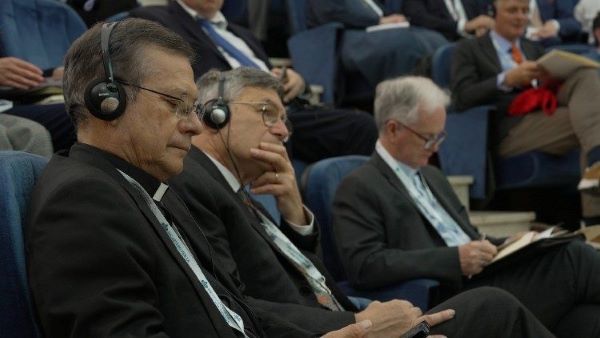 Key speakers at the afternoon session of the International Conference on Artificial Intelligence in the Vatican paint a sobering picture of what could be a dystopian future for humanity as AI increasingly shapes our reality. They also convey hope and optimism as men and women of goodwill are called to take action in the service of the common good.
Pope Leo’s upcoming encyclical, “Magnifica humanitas, on safeguarding the human person in the time of artificial intelligence” and his recent Message for the 'World Day of Social Communications' on the theme “Preserving human faces and voices” are a clear indication of the significance he places on what increasingly appears to be the defining issue of our time: Artificial Intelligence and the need to steer it for the good of humanity.
“Preserving human faces and voices” was also the title chosen for an international Conference at the Pontifical Urbaniana University on Thursday, which saw an impressive line-up of key speakers from the world of digital technology, education, and culture reflecting on the impact of AI on society and on the three pillars indicated by the Pope in his Message.
The 3 pillars: Responsibility, Cooperation, Education
The afternoon focused on how the three pillars indicated by the Pope in his Message - Responsibility, Cooperation, and Education - must be practically applied to ensure technology remains an instrument of human domain rather than of human subservience.
Responsibility: Ethical guarantees over profit
We are at a crossroads where the human face must not be replaced by an algorithm, nor the human voice silenced by synthetic echoes, said Neil Lawrence, DeepMind Professor of Machine Learning at the University of Cambridge.
'Responsibility means choosing accountability at every stage of development, ensuring AI serves human dignity rather than exploiting it,' explained Daniel Dzuban, Acting Chair of the Coalition for Content Providence and Authenticity and Head of Strategic Partners, Content Authenticity, Sony Electronics.
Cooperation: A global pact for the common good
The dystopian future painted by some panellists - one of extreme surveillance, deepfakes, and deep social alienation - is not an inevitability, but a warning, they agreed. To counter it, speakers called for an alliance between tech giants, policymakers, theologians, and civil society.
They also agreed that algorithmic progress must be matched by moral progress, noting that no single nation or corporation can steer Generative Artificial Intelligence alone.
Global cooperation rooted in solidarity is necessary, they said, to ensure that the digital divide does not become an unbridgeable chasm.
Education: Forming minds and hearts
The final pillar, Education, was upheld as the ultimate defence mechanism for preserving humanity. Education in the age of AI cannot merely be about teaching technical skills or coding, they explained; it must be focused on fostering critical thinking, empathy, and spiritual discernment.
'To think, network, and learn in the time of AI means teaching our youth not just how to use these tools, but how to remain profoundly human while doing so,' professors and UNESCO representatives agreed, highlighting the need to provide Media and Information Literacy (MIL) so that the future generations are able to recognise truth from fabrication, and presence from mere connectivity.
A call to action
Despite the warnings of algorithmic bias and the erosion of authentic human interaction, the overarching sentiment of the conference remained one of optimism and hope. The consensus of the afternoon was clear: the future is not yet written.
By centring our technological advancements on the authentic preservation of human faces and voices, humanity, participants agreed, can navigate this digital frontier. The conference concluded with a collective echo of the Pope9;s appeal - a reminder that men and women of goodwill hold the ultimate power to shape a future where technology must be “steered” to serve the common good.
The power of human agency
Speaking at the conclusion of the conference, Bishop Paul Tighe, Secretary of the Dicastery for Culture and Education, which organised the event in conjunction with the Dicastery for Communications, shared his takeaways from the event.
For Bishop Tighe, the most vital revelation of the day was a rejection of passivity. 'There’s so much information, it’s almost like we’re overwhelmed,' he observed, noting how easy it is to adopt a fatalistic 9;wait and see9; attitude in the face of such rapid change. 'I think the top takeaway for me is that this is a conference that reminded us that there9;s nothing inevitable about the future of AI.'
Instead, the Bishop pointed to a single, defining word: Agency.
He introduced a concept raised during the proceedings - 'Regency' - which he described as 'the agency that comes when people work together to build communities.' The conference itself served as a living example of this collective power.
'It brought people from tech, people from the education establishment, and people from more marginal parts of our world into a discussion about how we, the people, we humanity, can make sure that this wonderful new technology will actually serve to progress the interests of all of us.'
Asked how the speakers unified around the three pillars highlighted in the Pope9;s message, Bishop Tighe mapped them directly back to this urgent need for human agency:
Responsibility: 'When to AI and when not to AI'
The Bishop linked responsibility directly to intentionality. 'It’s related to that agency thing,' he explained, 'where the different responsibilities we all have - from engineers to entrepreneurs to the public consumers - [require us] to be attentive and intentional about what we9;re doing in terms of our use of AI.'
Ultimately, he explained, responsibility forces us to confront a fundamental question: 'when to AI and when not to AI, just to keep alive our own agency.'
Education: Developing critical awareness
Education naturally flows from this ethical responsibility. According to Bishop Tighe, it isn9;t just about technical literacy, but cultivating a deeper understanding.
'It9;s to educate people about how AI works so that they can have a critical awareness of its strengths and its weaknesses, and educate themselves in terms of the best uses.'
Cooperation: A transversal alliance
Finally, addressing the pillar of cooperation, the Bishop stressed that because AI touches every facet of human life, isolated solutions are useless.
'We need to build an alliance between various constituencies to ensure that we have an adequate response to something that is transversal,” he said.
His Dicastery, he concluded, is looking forward to working with the new Interdicasterial Commission on Artificial Intelligence recently established by the Pope.
“I think that will be very helpful because the issues of AI are issues that cross life: economic issues, war and peace issues, educational issues and communications issues. No one dicastery', he reiterated, 'can do this. We have to do this together!”
Linda Bordoni
Source: vaticannews.va/en