
Argentine Bishops to take up Pope Leo’s challenges for pastoral work
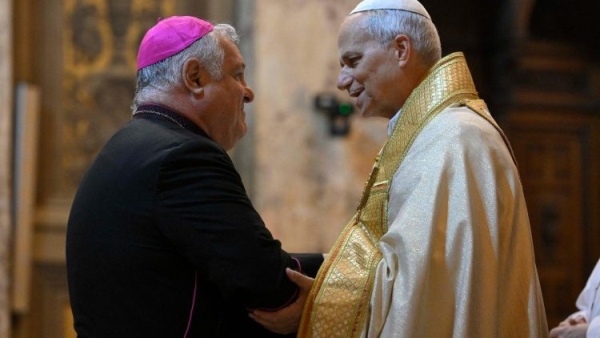 The Archbishop of Buenos Aires and the President of the Argentine Bishops' Conference offer a positive assessment of Pope Leo XIV’s visit to Argentina, highlighting the impact of his message and the challenges he posed for the Church’s pastoral work in the country.
Archbishop Marcelo Colombo of Mendoza, President of the Argentine Bishops’ Conference (VATICAN MEDIA)
After four days spent with the Argentine people, Pope Leo XIV left the country after midday on Wednesday, November 11, to continue his Apostolic Journey in Peru.
In Argentina’s streets and media, people are expressing joy, emotion, and, above all, gratitude for a visit that touched the population well beyond the Catholic faithful.
Archbishop Marcelo Colombo of Mendoza, President of the Argentine Bishops’ Conference, and Archbishop Jorge García Cuerva of Buenos Aires offered their initial assessments of this historic event and reflected on the paths now opening up for the Church community in the following interviews.
Q: Archbishop Colombo, what are your first impressions now that Pope Leo XIV’s historic visit to Argentina has ended?
It is a great invitation to joy, hope, and communion among the Argentine people, to deepen everything that unites us, everything God has given us.
On several occasions, the Pope spoke of the country’s natural beauty and the beauty of the Argentine people as gifts that enable us to celebrate God in our lives.
Q: Were you expecting such a large turnout for the events?
We were expecting it because we could see the number of inquiries and bookings, the buses, people’s eagerness to register, the priests—everyone wanted to take part. So yes, millions have been able to see Pope Leo and pray with him.
And there was affection from the young people, whose warmth and spontaneity won the Pope’s heart on several occasions.
Q: What stands out to you in the Holy Father’s words to civil society, and how do these messages affect the local Church’s dialogue with it?
Fundamentally, there is a particular emphasis on the dignity of the person, of every person, and the special care the Church takes of the lives of the poor and vulnerable, as part of that social dialogue, that invitation to work together as a society.
Q: Turning to the Church’s work, the Pope reaffirmed the continuing relevance of the Christian model of the family and strongly called on each and every person to take responsibility for playing an active role in evangelization. What new stage begins today for the pilgrim Church in Argentina?
First of all, we need to respond to what the Pope has told us through heartfelt, profound reflection. In the coming days and months, we owe it to ourselves to read his words more closely, discuss them, and share them in a spirit of fraternity within our communities and among the bishops.
Then we need to translate this into pastoral choices and decisions, as we are already doing, because for several years we have been following the synodal path first proposed to us by Pope Francis, which Pope Leo now invites us to pursue more deeply.
Q: Pope Leo came to Argentina following in the footsteps of Jorge Mario Bergoglio, Pope Francis, who, although he never returned to his homeland, seems never to have been absent. What role did Pope Francis play in this visit?
First of all, he was present in the fervor of the people who came, who remember him, applaud when his name is mentioned, and thank God for his life. Naturally, there is also thanksgiving to God for this Pope.
We recognize that he worked closely with Pope Francis and that, in a way, with a new agenda, new emphases, and a personality of his own, he brings us the richness of a legacy that is always the Gospel, translated for our times into the choices of the universal Church.
Archbishop García Cuerva: “I think we have made ‘Everyone is welcome’ a reality”
Q: Archbishop García Cuerva, what will you take away from these days in Argentina, and what is your first impression of what you have experienced?
There are so many emotions close to the surface, and a profound joy among our people at having been able to meet the Holy Father. There is also the joy of discovering that we truly all felt invited.
As you know, the first part of the motto for this visit was “Everyone is welcome,” and I think we have made “Everyone is welcome” a reality. So, it was not only the joy of witnessing the encounter with the Holy Father, but also the joy of seeing that we all felt invited to take part. That is why every Mass and event drew truly enormous crowds, exceeding all, absolutely all, expectations.
Third, I am beginning to feel that the Pope is leaving, but we have a great deal of work ahead of us and many commitments to fulfill. We will have to translate this mobilization, this missionary impetus the Holy Father has given us, into the concrete reality of everyday life.
Q: The Holy Father’s relationship with young people attracted considerable attention. It was also one of the most important and sensitive aspects of this visit, given the situation they face in Argentina, with many personal wounds and high unemployment, for example. What challenges does the Argentine Church now face in youth ministry, but also in its relationship with civil society and young people in general?
I think we now see clearly that our young people have a great deal of faith and a deep desire for transcendence. As St. Augustine said, “You have made us for yourself, O Lord, and our heart is restless until it rests in you.”
Yesterday, the Pope encountered the restless hearts of so many young people who thirst deeply for God, who thirst deeply for Jesus and want to know Him better. So, we have an enormous responsibility to accompany them in their vulnerability and in their talents.
Yesterday, the performance we presented to the Holy Father, put on by young people, brought together art, dance, and music. Young people are capable of beautiful things, and I think they must have a special place in our Church and in our society.
Q: The Holy Father also expressed both concern and encouragement for consecrated persons. In large cities such as Buenos Aires, where you are the chief pastor, is this weariness evident in the ministry of priests and the service of women religious?
Yesterday, the Holy Father used a very vivid image. He said that as the years pass, perhaps we end up severing our relationship with the One who called us and the One for whom we say we work.
In other words, we say we work with Christ, but our relationship with Him grows weaker. I think the first thing we need to do is return to prayer and to our first love. In that sense, all of us who have consecrated our lives to God need to draw nourishment once again from the Lord Jesus, to center our ministry and our consecration once again on Jesus Christ. That is why prayer is so essential: it enables us to fall in love with Christ again and center our consecration on Him in these difficult times, amid all the competing pressures of daily life.
Q: The Holy Father defended the role and image of the Christian family. He said it was a model that had not been superseded and remained relevant. In the face of today’s social challenges, what role does family ministry play? How does the Church strengthen the family as the nucleus of society? How does the Pope challenge us in this regard?
As I accompanied the Holy Father in the popemobile, it was very interesting to see how many young couples were holding up signs: “Holy Father, bless us,” “We’re getting married,” “We’re going to get married,” “We’ve just got married.” Then there were all the children they brought to the Holy Father.
Seeing young families who, despite their difficulties, still want to move forward gave me a great sense of hope. We will need to accompany them, above all, in strengthening the foundations of family life: returning to values, to the value of fidelity, of love and mutual self-giving, of selfless work, and of lifelong commitment.
I believe these values are the foundations of the family, and we need to keep emphasizing them, instilling them, and accompanying families so that, amid the storms, families built on rock will stand firm, as chapter 7 of St. Matthew’s Gospel tells us.
Felipe Herrera-Espaliat – Buenos Aires
Source: vaticannews.va/en