
Artists’ records become a living archive of St. Peter's Basilica
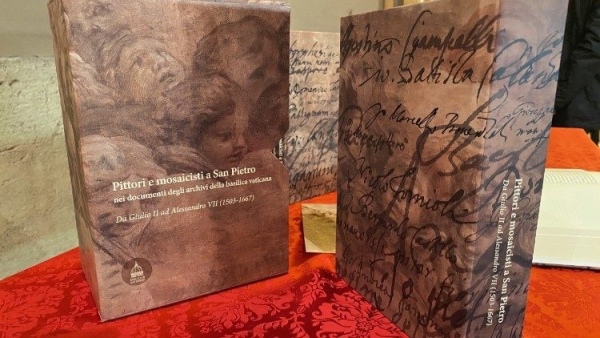 A three-volume work, Painters and Mosaicists at St. Peter’s Basilica, documents a century and a half of artistic activity in the Basilica, reconstructed through archival records was presented in the Hall of Blessings at the Vatican. This historical material is now being brought to life as an “integrated Living Archive” within the “Digital Twin” developed by Microsoft.
The boxed set of the three-volume work Painters and Mosaicists at St Peter’s Basilica, presented alongside the Living Archive in the Hall of Benedictions
The history of St. Peter’s Basilica is not only the story of great names such as Raphael and Pietro da Cortona. It was also shaped by outstanding artists whose contributions have remained in the shadow of the giants of art history. For many of them, all that survives is a signature on a payment order, an estimate for a piece, or an official decree. By studying archival documents, these artists are emerging from obscurity, opening up new avenues for study and research.
As Archbishop Vittorio Francesco Viola, Vicar General of Vatican City, Archpriest of St Peter’s Basilica and President of the Fabric of St Peter, observes: “The history of St. Peter’s is marked by continuity and transformation. Each age has worked with what it inherited, preserving some works, transforming others and introducing new ones, according to the tastes and styles of the time.”
The three-volume work Painters and Mosaicists at St. Peter’s Basilica in the Documents of the Archives of the Vatican Basilica brings renewed attention to the artists active during the decisive period in the construction of the new Basilica, from the beginning of the rebuilding project commissioned by Pope Julius II in 1503 to the end of the pontificate of Alexander VII in 1667. Published by Edizioni Basilica di San Pietro, the work is edited by Assunta Di Sante and Alexis Gauvain, with contributions from Valentina Balzarotti. It reconstructs the careers and activities of more than two hundred painters, mosaicists and illuminators.
The volumes were presented on Tuesday, 17 November, in the Hall of Benedictions, a place of considerable symbolic significance. Thanks to its extraordinary dimensions and the natural light streaming through the large windows overlooking the façade, the hall served for centuries as a workshop for the Fabric of St. Peter, accommodating craftsmen and artists, including master mosaicists involved in creating and restoring the Basilica’s monumental altarpieces.
Pope Urban VIII celebrated the dedication of the new St. Peter's Basilica on 18 November 1626. Today, four centuries later, the heart of that workshop continues to beat. One of its most modern expressions has emerged from the place where tradition and innovation meet, embodied in the collaboration between the Fabric of St. Peter and Microsoft.
No longer will the collection of documents recording the painting and mosaic work carried out by the many generations of craftsmen who contributed to the church built over the tomb of the Apostle Peter remain confined to the printed page. Thanks to the Basilica’s Digital Twin and artificial intelligence, it is becoming a living archive, open to scholars, pilgrims and visitors from around the world.
“It is wonderful to think,” Archbishop Viola remarks, “that today these records can be explored using tools we could never have imagined when the research began almost twenty years ago.”
An ambitious editorial project
“The reference work we are presenting grew out of an editorial project launched approximately six or seven years ago, bringing together the results of research that had actually begun some twenty years earlier,” explains Assunta Di Sante, archivist of the Fabric of St. Peter.
The project involved the Fabric’s archivists and approximately eighty art historians. The original idea was to publish the documents themselves. Then came a turning point: “We realised that the reference work should begin not with the artworks, but with the artists.”
The result was a prosopographical dictionary, reconstructing the biographies of this community of artists and craftsmen, their activities on the construction site and the relationships among the master artists.
The research subsequently expanded to include artists commissioned by the Chapter of St. Peter’s and the Archconfraternity of the Most Holy Sacrament, as well as archival documents held in eleven different institutions, ranging from the Vatican Apostolic Library to the State Archives of Rome.
The period under investigation was no coincidence. The year 1503 marked the election of Pope Julius II, who initiated the rebuilding of the Basilica and who founded the Fabric of St. Peter in 1506. The year 1667 marked the end of the pontificate of Alexander VII, who was responsible for Bernini’s colonnade.
“We felt this was a significant chronological span for telling the story of the Vatican Basilica: one century devoted to its construction, followed by another century of decoration.”
Art rediscovered behind Pope Paul III’s wall
The archival material consists largely of construction-site documents: payment orders, estimates for works and decrees. Yet, Di Sante explains, even these highly detailed administrative records reveal “an unexpected story”.
While the Fabric was building the new Basilica, the Chapter continued to celebrate liturgies in the old section of the church, separated from the construction site by a wall commissioned by Pope Paul III in 1538. That way, “the liturgy never came to a halt” in the Basilica.
For the Jubilee of 1575, the Chapter commissioned the decoration of areas that were already destined for demolition. Di Sante describes how the team “rediscovered the figure of an artist who, until recently, had been considered relatively minor: Pietro Mongardini. In 1575, he decorated the entire area around Pope Paul III’s wall with extraordinary decorative works, knowing full well that they would eventually be demolished.”
From the book to the Living Archive
The reference work, Painters and Mosaicists at St. Peter’s Basilica, is connected to the Basilica’s Digital Twin, developed by Microsoft for the Fabric in 2024. This is a three-dimensional model created from more than 400,000 high-resolution images captured inside St. Peter’s using drones, cameras and laser technology.
“Two years ago, together with the Fabric of St. Peter, we brought the Basilica into the digital world. Today, we are taking another step forward: giving that Digital Twin a memory,” says Jeff Bullwinkel, Vice President of Microsoft EMEA. “With the Living Archive, technology brings people closer to the knowledge preserved by the Fabric of St. Peter, without ever replacing it.”
Artificial intelligence does not generate content. Instead, it organises and connects knowledge produced and verified by the Fabric, making it possible to search and explore that knowledge through questions.
Unlike a straightforward digitisation project, the Living Archive, Di Sante explains, “establishes connections between images and the artworks in the Basilica and the artists who created them”.
While three printed volumes weighing four kilograms each inevitably have a limited circulation, a digital archive accessible to anyone, anywhere in the world, offers very different possibilities.
“Everyone will be able to use it, provided they can access the Digital Twin, which is freely available on the Basilica’s website,” Di Sante assures.
In the first months of 2027, the Fabric hopes to incorporate further publications into the system, ensuring that their contents are firmly grounded in scholarly research and validated by the Fabric itself.
A fruitful partnership between print and digital technology
“While I was preparing to publish this reference work,” the archivist confides, “I was almost afraid of seeing it come out.”
The printed book remains an irreplaceable experience, but it also has its limitations. The Living Archive opens up new research possibilities and allows different sets of data to be cross-referenced in ways that print cannot accommodate.
The book and technology, she concludes, are not competitors: “They are two complementary tools. In this case, technology supports research and will also help this reference work evolve.”
Discernment and evaluation remain human responsibilities
For Archbishop Viola, the relationship between research and technology is precisely the crucial issue.
“Behind every piece of information we make available there is the work of a human being. Documents do not speak for themselves: we must know how to read them, place them in their proper context, compare them with other evidence, recognise their gaps and, sometimes, accept that they do not allow us to reach a definitive answer,” he explains.
Artificial intelligence in support of critical thinking
For this reason, the Living Archive is based on content produced and validated by the Fabric and the Chapter, with sources and the authorship of contributions always clearly identifiable.
“Discernment and the evaluation of content therefore remain human prerogatives. Artificial intelligence should encourage the exercise of critical thinking and help us formulate new questions. It is up to us, however, to determine responsibly how it should be used and where its limits lie, with the well-being of people as our constant guiding principle.”
A welcome that reaches beyond the Basilica’s walls
The project does not have one particular audience in mind. Rather, it aims to allow everyone to choose their own path of discovery, including those who may never have the opportunity to visit Rome.
“Digital accessibility thus takes on a dimension of justice, fraternity and inclusion, even before it becomes a cultural matter,” emphasises Archbishop Viola.
Reaching those who are far away
There is also a pastoral dimension to the project.
“The Basilica welcomes people of every faith and background, each with their own story, questions and sensibilities. Digital tools can help us reach those who are far away, offering them the opportunity to learn and explore more deeply, without seeking to direct anyone’s personal journey.”
Sometimes, all it takes is a moment spent looking at an image to see it with fresh eyes.
“Curiosity can give rise to a deeper question, perhaps even one about faith. I believe that offering this opportunity, discreetly and with respect for everyone's freedom, is already a way of participating in the Basilica’s mission.”
Archbishop Viola describes St Peter’s as “the heart of Christianity and an extraordinary monument built over the tomb of a humble fisherman from Galilee. For centuries, it has stood as a visible and tangible sign of the fulfilment of the mandate entrusted by Our Lord Jesus Christ to Peter: ‘You are Peter, and upon this rock I will build my Church.’”
Thinking of a pilgrim living far away, the President of the Fabric imagines that this person “will be able to discover St. Peter’s by following their own curiosity, without necessarily having to begin with what they already know”.
They may discover “something that is often overlooked in the face of the Basilica’s grandeur: the work of generations of people, their skills, their faith and the human stories intertwined with the history of this place”.
“Those who have already visited St. Peter’s will be able to return there in their imagination, rediscover a particular work and learn more about it. Those who hope to visit one day will be able to prepare for that encounter, while those who know they will never be able to travel to Rome will nevertheless have the opportunity to draw closer to this heritage,” he notes.
The hope is that this new tool will “inspire new questions and a desire to explore more deeply, helping everyone, even from afar, to feel that the Basilica is a home.”
Paolo Ondarza
Source: vaticannews.va/en