
As Pope Leo visits Peru, young people welcome new reasons to hope
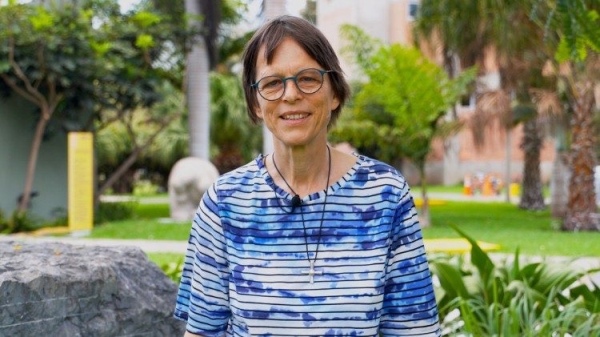 At the Pontifical Catholic University of Peru, two theologians and a political scientist speak about the faith Pope Leo XIV came to know as a missionary, the choices facing young Peruvians and what reconciliation would ask of their country.
Sr Birgit Weiler (@VaticanNews)
“Pope Leo, welcome home.” Sister Birgit Weiler has been seeing those words on posters around Lima. At the Pontifical Catholic University of Peru, where the Medical Mission Sister teaches theology, she hears a different question from her students as they think about their own future in the country. “Where will there be a place for us?”
Some wonder whether the jobs they are training for will still exist as artificial intelligence changes the workplace. Others worry about what will happen to their families if floodwaters reach their homes or drought ruins a harvest. And for young people who have had to overcome gaps in their schooling to get to university, there is the immediate question of how to keep up once they arrive.
As Pope Leo XIV visits Peru, Weiler hopes he will encourage young people to see what they can already contribute to their country. The Pope, she says, knows something of the hardships their families face “because he lived simply among the people.”
A faith he knows from within
The future Pope began his missionary ministry in Peru in 1985, when he was assigned to the Augustinian mission in Chulucanas, in the northern region of Piura. He would go on to serve as Bishop of Chiclayo.
For Véronique Lecaros, who heads the university’s theology department, those years gave him a familiarity with the ways Peruvians live their Catholic faith. In communities where priests have long been scarce, she says, laypeople have kept the faith alive through processions, pilgrimages and patronal feasts. She has met Peruvians who consider themselves Catholic even though they have never been baptised. Others rarely go to Mass and would never miss a procession.
“We bless everything in Peru,” she says. There is holy water in the house, a candle to light and a pilgrimage to make each year. These practices, she explains, are “a way of entering into a relationship with God and feeling that God accompanies us.”
In Chulucanas, Lecaros says, the Augustinians built on that devotional life, offering formation and encouraging the mutual support already present in the communities. She sees a connection between that experience and the warmth with which many Peruvians now welcome Leo. “For them, he is a pope who recognises them, and they recognise him,” she says.
Making room for young people
Back in the classroom, Weiler sees students asking what a polarised society will require of them as future engineers, teachers and other professionals. They bring questions about inequality into class, she says, and look for practical ways to help one another. For students whose schools left them less prepared for university, tutoring and support from classmates can make a difference.
Young people want their “gifts, skills, imagination and creativity” to count in decisions that affect them, Weiler says. In her course on Laudato si’, integral ecology and the theology of creation, she invites Indigenous guests to speak with engineering students about how their communities understand their relationship with the land and with other living beings.
She hopes those encounters will shape how students work after graduation, particularly when they enter communities whose experience differs from their own. “You learn how to connect with the people,” she says. “Different ways of knowing can come into the picture,” helping them find better answers to the problems they face.
Building reasons to hope
León Lucar, a political scientist who works in the theology department, hears the question of opportunity in conversations about leaving Peru. An education does not always lead to a job, he says, and moving to Lima can mean trading limited prospects at home for hours in traffic and a cost to one’s health. He asks how Peru’s macroeconomic stability translates into the daily lives of people trying to build a career, start a family or make a life of their own.
One reason for hope, he says, can be found in the ollas comunes, the community kitchens where neighbours pooled what food they had during the pandemic. He recalls Caritas and educational institutions helping women involved in the kitchens learn how to preserve food and make better use of what was available. Running the kitchens also meant learning how to approach local authorities and speak up for what their communities needed.
“When we see people’s initiative, we begin to see how much hope there is,” Lucar says. He hopes the Pope’s visit will encourage young people to exercise that same initiative in education, the arts, business and public life.
Reconciliation and justice
For Lucar, the visit also raises a harder question about what Peruvians mean when they speak of reconciliation. He points to the families of those killed during the protests that began in December 2022. Human Rights Watch documented the deaths of 50 protesters and bystanders between December 2022 and March 2023.
“Reconciliation implies justice,” Lucar says. For him, that means listening to victims and their families, holding those responsible to account and taking steps to make amends.
He recalls the appeal that stayed with him after Pope Francis’ visit: “Do not let yourselves be robbed of hope.” As Pope Leo visits the country where he served for years, Lucar hopes young Peruvians will hear that appeal again, alongside an invitation to take part in the life of their country. “We also have to build these reasons for hope,” he concludes.
Francesca Merlo – Lima, Peru
Source: vaticannews.va/en