
Brother Olivier-Thomas Venard: ‘We are comforted by not feeling alone'
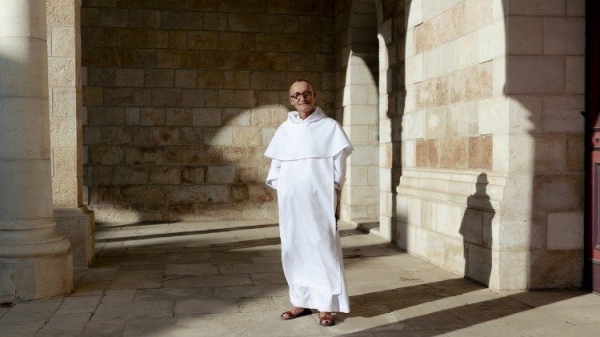 The Dominican friar, who has lived in the Holy Land for 25 years, directs the research programme The Bible in Its Traditions at the École Biblique et Archéologique Française in Jerusalem. In an interview with Vatican News, he reflects on the increasingly tense atmosphere in the region, the dehumanising language used in public discourse, and the quiet, everyday work of dialogue.
Brother Olivier-Thomas Venard
Brother Olivier-Thomas Venard is a distinctive and sought-after voice in Jerusalem, a city he has called home for 25 years. During this quarter-century, the former student of the École Normale Supérieure, who works at the École Biblique et Archéologique Française (EBAF) and directs its research programme The Bible in Its Traditions, has continued to nurture intellectual friendships on both the Israeli and Palestinian sides. He has also witnessed violence that seems to know no limits, as language increasingly slides into dehumanisation.
At the end of October, Brother Venard left his convent of Saint Stephen in Jerusalem to travel to Rome. He visited our studios to share his experience, speak about his work in the land “where the Bible was lived”, and reflect on the essential work of dialogue and reconciliation to which Christians in the Holy Land are called.
How would you describe the current situation in the Holy Land, marked by violence and, at times, an outpouring of hatred?
In my 25 years in the Holy Land, I have observed that, from the standpoint of human rights, each year is worse than the one before. To all my friends who tell me, “We are planning to come, but we are waiting until ...”, I now say: “Don't wait any longer. You need to come while it is still possible.”
My time in the Holy Land began with the ten years of the Second Intifada, following the disappointed hopes raised by the Oslo Accords. At the end of that first period, I gathered together all the reflections I had written – accounts of walks, interviews, investigations and more in-depth articles – in a book entitled Terre de Dieu et des hommes [Land of God and Men].[1]
People have often asked me why this land is “holy”. I believe it is holy because everything that happens here, both good and bad, has something to teach the rest of the world.
At the end of that book, I thought I could bid farewell to writing about the Holy Land, declaring that I would no longer write about it because I already found the situation so desperate. In conversations with my Jewish friends, I realised that they shared my concerns about a kind of ethnic and territorial regression within Judaism, as we have come to appreciate it in the Diaspora, shaped by thinkers such as Emmanuel Levinas. Sadly, the horrors of 7 October and the war that followed compelled me to take up my pen again.
The dehumanisation of the other seems to have become a feature of certain forms of discourse. Have you experienced this personally? How would you describe it?
We have experienced it at close quarters in recent months. Last May, my principal collaborator, a consecrated virgin of the Latin Patriarchate, was violently assaulted on Mount Zion by a religious Zionist Jew, who was acquitted four months later on the grounds of mental illness.
This violence, however, is part of a broader pattern of highly intolerant discourse directed against Christians in certain circles. This is first and foremost a question that we must put to our Jewish and Israeli friends.
Although I want to emphasise the dramatic nature of the situation we are living through, I would also like to say straight away that, thank God, there are some wonderful and enlightened people in Jerusalem.
Two days after the assault on our sister, two of our colleagues, distinguished professors at the Hebrew University, came to see us with tears in their eyes. They brought a bouquet of flowers and a petition signed by more than 300 Israeli university colleagues, expressing their shame and dismay. It was deeply moving and a genuine source of comfort for us.
An Israeli lawyer and friend, Yisca Harani, has founded an association to defend religious freedom in Jerusalem. She recruits dozens of Israeli volunteers who use their smartphones to monitor and document incidents in which Christians are spat upon or subjected to violence. They seek to document these incidents and pursue legal action. When students from a particular yeshiva are identified, they may even go there to offer educational initiatives, wherever possible.
We are comforted by knowing that we are not entirely alone. It helps us maintain the calm and composure of seasoned veterans.
The convent of the Order of Preachers, or Dominicans, to which I belong, has been running the École Biblique et Archéologique Française in Jerusalem for almost 140 years. Throughout its history, the School has witnessed several changes in sovereignty over the Holy City. Our mission remains to cultivate, peacefully, rationally and prayerfully, the memory of all the peoples who live on this land.
To this end, we have established one of the world's finest biblical libraries and continued a tradition of excellence in bringing together the study of the “monument” – archaeology – and the “document” – the many different written traces of the Word of God. This historical perspective informs the way we speak about these issues.
In your 2025 essay, 'Il nous reste la foi' (We Still Have Faith), you write: “Today, everyone seems to be compelled to choose one side, unequivocally and without nuance.” Are Christians able to resist this pressure? Is it their role to do so? And are they succeeding?
We must be careful not to generalise. Nevertheless, the fact is that it is primarily religious Christian Zionist circles that promote a distorted interpretation of Scripture, one that ends up justifying the expulsion from the Holy Land of a mythical Amalek, identified with the Palestinians.
In response to these aberrations, Christians rooted in the Tradition – whether they belong to the apostolic Churches or to the Anglican and Lutheran ecclesial communities, which are very much alive within Palestinian Christianity – offer the wisdom of Tradition.
On the one hand, the essential elements of the Christian faith cannot be understood without Judaism and the Jewish world. On the other, the Gospel's central imperative of charity towards all opens this inheritance up to everyone.
As Jesus says, God is worshipped neither “on this mountain nor in Jerusalem”, but “in spirit and truth” (Jn 4:21-24). Our neighbour is no longer simply someone who resembles us or belongs to our own people, but every person in need of our help.
Whether consciously or not, anyone who seeks to “take up their cross” each day and follow Jesus Christ finds themselves at the heart of the journey towards peace.
In our own way, this is what we seek to do at the École Biblique through our academic work: to discover and cultivate a form of light that can bring goodness to all. We need everyone to help the Word of our most loving Father shine forth, as He gives Himself to us through the Scriptures.
That is why I believe that, in peace negotiations – if there were any, since today we are so far from them! – Christians from the major Churches have a role to play.
The title of your book, 'Il nous reste la foi' (We Still Have Faith, Paris: Grasset, 2025), raises a question: is faith what enables us not to despair amid this ocean of violence, where the other is sometimes reduced to an enemy?
Above all, we need to rediscover the richness and flavour of faith, of the text and of the Word. This is also our vocation.
How can we draw from religion, at its most intimate level, what we Catholics call the “theological life”? How can we rediscover religion in the sense in which St Thomas Aquinas speaks of it: the virtue of religion, which means that we worship God alone and recognise that everything else is relative?
Seen from this perspective, religion offers entirely unexpected resources. Across the different monotheistic traditions, there are possibilities for reconciliation, or at least for compromise and forgiveness, in the Holy Land.
I like to say that the Bible, as the Good Lord has actually handed it down to us, in the truth of history and culture, is a challenge to the intellect. Perhaps this is our principal mission in the Holy Land, at least as Dominicans, intellectuals and theologians: to remind people of the distinction between what is absolute and what is relative.
You say that “we must dare to speak”. Your book opens with Psalm 115: “I believed, and so I spoke.” Do people around you still believe in the power of words? And, above all, in what kind of words?
First of all, we must simply believe in human speech, in all its simplicity. Is it still possible to describe facts and arrive at the truth through words?
For the past 15 years, we have been hearing talk of “alternative facts” from the most powerful centres of authority in the world!
There are two possibilities. Either truth exists, and we can make a collective effort to reach it; on the basis of the description of reality that we manage to formulate, however imperfect it may be, we can then seek solutions. Or else we are reduced to setting each person's “truth” against everyone else's, thereby establishing a war of all against all and the law of the strongest.
That is precisely where we are in the Holy Land.
It is striking to read the work of the finest Israeli journalists and see how frequently they raise this question: we must finally find a way to describe the situation accurately.
For some, these are territories that could form part of a future Palestinian State. For others, they are simply Judea and Samaria, territories that have been de facto annexed.
From the latter perspective, the inhabitants of these territories are merely “residual Arabs”, remnants of the Ottoman Empire. From the former perspective, they are Palestinians defending a legitimate national cause, in accordance with the right of peoples to self-determination under international law.
Even simply stating the problem has become a problem! We must finally make an effort to describe the facts anew.
As Catholics, ever since “the Word became flesh” and certain definitive words of His were handed down to us through the cultural and literary mediation of the Gospels, we have believed – and know – that human beings can take truth as the horizon towards which their words are directed.
Could you tell us about the major project you are involved in, entitled 'The Bible in Its Traditions?' What is it about?
The mission of the École Biblique is to transmit the Word of God, or, more precisely, the written traces of the Word of God, which we call the Bible or the Holy Scriptures.
When our School was founded in 1890, the academic world believed that various archaeological, palaeographical and historical discoveries were calling sacred history into question and, perhaps, with it, the entire edifice of traditional dogma.
While some were tempted to respond to this crisis solely through the exercise of authority, our founder, Father Marie-Joseph Lagrange, chose simply to engage in scholarly research. If archaeological questions were being raised, science and faith had to be brought together, and archaeology had to be carried out on the ground.
This has been our hallmark from the very beginning: to transmit to the People of God the best available understanding of the Word of God.
Over the past 140 years, major discoveries have been made, particularly the discovery of the Dead Sea Scrolls at Qumran. These have shown, for example, that the quest for a single “original” text is something of an illusion. The transmission of Scripture has always involved a certain diversity.
Transmitted in Hebrew, Greek, Aramaic, Syriac and Latin, the Scriptures constitute a genuine polyphony. This diversity of versions and texts is not a flaw in Scripture. It is how God has willed them to be, and it deserves to be celebrated! Through The Bible in Its Traditions, our first aim is to restore this polyphony.
Furthermore, the meaning of a work cannot be reduced solely to the concrete circumstances in which it emerged in history. To grasp its full meaning, we need to broaden our perspective to include what is known as the history of reception: as far back as we can trace, every text has had an impact, including on the history of art. Our collective memory is already filled with these influences before we even open the Bible.
Our research programme is organised around an online laboratory that we have established (bibletraditions.org). Dozens of biblical scholars, theologians from several Christian traditions, specialists in the ancient world, and historians of art, music and literature work together there to retranslate the different versions of the Scriptures and make this extraordinary richness accessible through multimedia notes.
For example, we have completed an inventory of all the botanical references in the Bible, and this year we are bringing our exploration of its fauna to a close! All this material is available at Bibleart.com.
Has your identity as a Dominican religious been transformed by these years in Jerusalem, particularly in the light of the recent violence?
Profoundly so.
The situation forces us once again to return to the heart of the Gospel and discover that, as Cardinal Charles Journet used to say, “the boundaries of the Church pass through the heart of every human being”.
We have spoken about the considerable confusion surrounding the word “Christian” in the Holy Land today, where some advocate unjust conquest while others call for compromise and sharing.
Ultimately, what matters is finding the key to a path towards peace. Is God, whatever image I may have of Him, a personal and demanding presence who leads me towards the place where my soul, my interlocutor – whether male or female – is being led: towards greater understanding, compassion and intelligence?
It is through these encounters, multiplied many times over, that we eventually come to see this.
Those who originally established our biblical work coined a very beautiful expression: “We want to speak to the community of those who seek the truth.” I find this expression wonderful.
I conclude my book by affirming my faith in human reason because, for me as a Catholic Christian, it is clearly a participation in the divine Word, the Logos!
Benedict XVI spoke to us in this sense when he visited the Holy Land. He was both a great intellectual and a great devotee of Christ.
As he brought Christians, Muslims and Jews together, he told us, in essence: if we claim to believe, more or less, in the same God, perhaps there is one very first thing – a beautiful act of religion – that we could try to do together: make use of the reason He has given us!
Olivier Bonnel
Source: vaticannews.va/en
[1] O.-Th. Venard, Terre de Dieu et des hommes: écrits de Jérusalem, 2000-2012, Perpignan: Artège, 2012.
[2] O.-Th. Venard, Il nous reste la foi, Paris: Grasset, 2025.