
Eight Religious Traditions Gather for 16th Interreligious Meeting in Vietnam’s Saigon Archdiocese
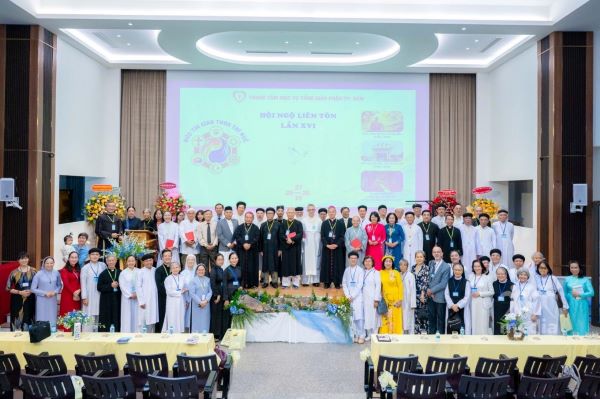 Representatives of eight religious traditions gathered in Ho Chi Minh City, southern Vietnam, on October 27 for the 16th Interreligious Gathering, where Church and religious leaders called for greater dialogue, ethical use of artificial intelligence (AI) and cooperation in building a peaceful society.
Held at the Cardinal John Baptist Pham Minh Man Hall of the Pastoral Center of the Archdiocese of Saigon, the gathering carried the theme “Faith Intersecting Wisdom.”
Archbishop Joseph Nguyen Nang of Saigon, president of the Catholic Bishops’ Conference of Vietnam, attended the event alongside Bishop Joseph Chau Ngoc Tri, chairman of the bishops’ conference Commission for Ecumenism and Interreligious Dialogue.
Participants represented Buddhism, Cao Dai, Islam, Hoa Hao Buddhism, the Bahá’í Faith, Minh Ly Dao, Minh Su Dao and Confucianism. Priests, religious leaders, lecturers and students from the Department of Religious Studies at the University of Social Sciences and Humanities in Ho Chi Minh City also attended.
The gathering commemorated several significant milestones: the 300th birth anniversary of Vietnamese cultural figure Le Quy Don, the centenary of the Cao Dai religion and the 60th anniversary of the Second Vatican Council declaration Nostra Aetate, which established a foundation for the Catholic Church’s engagement with other religions.
In his opening address, Archbishop Nguyen Nang reflected on the relationship between knowledge, artificial intelligence and human wisdom, emphasizing the need to place human dignity at the center of technological development.
“Humanity creates AI, but today AI is profoundly influencing and impacting human beings,” he said, noting that although AI can process information rapidly, it lacks humanity, responsibility and love and cannot provide the ultimate meaning of life.
“The question is not whether we should use AI, but how to use it while respecting the supreme dignity of every person, preserving moral conscience, and strengthening communion,” he said.
He added that religions have a responsibility to guide humanity toward wisdom and authentic happiness.
The symposium featured presentations from representatives of different religious and academic traditions.
Professor Thuong Tao Thanh of the Cao Dai Tien Thien Academy discussed the centenary journey of the Cao Dai religion, while Dr. Tran Ky Dong of the University of Social Sciences and Humanities examined AI's impact on religious life.
Sister Maria Teresa Avila Kim Trang spoke about Christianity's mission of holistic education, and Venerable Nun Thich Thanh Tam reflected on inner transformation through the Buddhist principles of the five faculties and five powers.
Cultural performances highlighting peace and charity further enriched the gathering.
A joint prayer service marked the emotional highlight of the event, commemorating the 40th anniversary of the World Day of Prayer for Peace. Representatives of the participating religions offered prayers for a world free from violence and division.
In his concluding remarks, Bishop Chau Ngoc Tri recalled how representatives had left their homes, temples, sanctuaries, pagodas and churches to gather in a spirit of fraternity.
“Though our religious names differ, we all look toward the Almighty. May He unite us into one great family of brotherly love, caring for one another and building a peaceful world,” he said.
The gathering concluded with the singing of the “Prayer of St. Francis,” reaffirming the participants’ shared commitment to interreligious dialogue, mutual understanding and peace.
The annual initiative reflects the spirit of Nostra Aetate, the Second Vatican Council's declaration on the Church's relationship with non-Christian religions, which encourages mutual respect, dialogue and cooperation in addressing challenges facing humanity.
Sandy Kim
Source: rvasia.org