
Human person at the center: Against structures of sin that generate exclusion
 Our Editorial Director reflects on Pope Leo XIV's address to the World of Work, saying it offers a comprehensive synthesis of Catholic Social Teaching and an affirmation of Pope Francis’s magisterium.
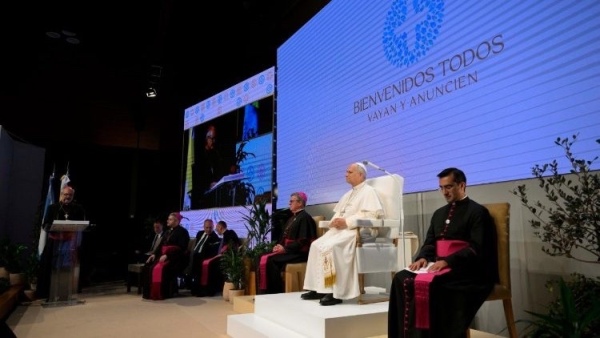
Pope Leo XIV meets with the world of work at the Catholic University of Argentina in Buenos Aires (VATICAN MEDIA)
Pope Leo has come to Argentina with a message calling for social fraternity and a move beyond polarization.
In his own distinctive style, he calls for unity and reminds everyone of their respective responsibilities, recalling the fundamental principles of the Church’s Social Teaching, which in certain cases expose the inadequacy of particular policies and the harm they cause, especially to the poorest.
The address he delivered at the Catholic University of Argentina during his meeting with representatives of the world of work is one that is destined to leave its mark far beyond this country.
Drawing on Pope Francis’ social encyclicals and documents, the Pope has shown how the themes and emphases introduced by his predecessor did nothing other than update the treasure represented by the Church’s Social Teaching: a hidden treasure, one might say, and still little known.
A treasure which, if put into practice in society, politics and institutions, would have a transformative power capable of bringing about a more just world.
In recalling Pope Leo XIII, the Successor of Peter reaffirmed that the human person 'is the centre and the goal of all economic and social life and, therefore, the economy must be at the service of the person, and not the person at the service of the economy.' This principle challenges a certain conception of the market, whose consequences are there for all to see.
As Saint Ambrose already explained, in words courageously cited by Pope Paul VI in Populorum progressio, the right to private property carries a social obligation. The goods of the earth are given by God for all humanity, and therefore no one can be considered an 'absolute owner.' Reaffirming this principle means giving voice to the cry of the poor.
To insist on the principle of solidarity, specifying that it “is not a superficial feeling of compassion, but the responsibility of each person and each institution for the good of all,” means putting one's finger on the wound of a globalized economy—driven by the immense power of financial markets—which tends towards a “throwaway culture”, and proposing a new social architecture.
To address business leaders and explain the social function of property and capital means pointing to the remedies for the disasters that so often arise when economic profit becomes the sole criterion of success.
To say, as Pope Leo XIV did, “When economic profit is established as the sole criterion of success, a business becomes dehumanized and turns into a structure of sin that generates exclusion,” is to recognize, in keeping with the social teaching of John Paul II, that the economy lacks “neutrality” and that the sin in the heart of the individual accounts for only part of what happens.
There are also “structures of sin,” structures that have become sinful and would need to be challenged through appeals to conscience as well as through bold, practical proposals to build new economic systems that are more just and more respectful of human dignity, “eliminating the structural inequalities that marginalize the weak.”
To call for technological development to be harmonised “with respect for the rhythms of nature and the limits of the various ecosystems,” as Pope Francis wrote in his encyclical Laudato si’, means highlighting that the challenge of caring for Creation and integral ecology—issues now overshadowed by the madness of the arms race—was not an ecological obsession of the Argentine Pope, but an important step firmly rooted in Catholic Social Teaching.
'This is an insight that remains valid even now, amid profound changes in the structure of work, when the interests of a few seem to prevail.”
To speak of artificial intelligence and unregulated automation as “a real threat to proper integral human development” means looking at what is happening in the world from the perspective of the least advantaged, reaffirming that “technology must always be subject to ethics.”
The Pope who took the same name as the author of Rerum novarum does not speak as a politician or a technical expert.
Rather, he proclaims an incarnate Gospel and proposes practical paths forward, inviting Christians and all people of good will to work concretely towards a change of paradigm and the establishment of more just systems.
Andrea Tornielli
Source: vaticannews.va/en