
Montevideo prepares to welcome Pope Leo as a 'caress from God'
 At the Estadio Centenario, workers are putting up the stage for a prayer vigil. In the Old City, hymns are being rehearsed for Vespers. As Montevideo prepares to welcome Pope Leo XIV, organizers hope his visit will speak to people across a city shaped by Uruguay’s secular tradition.
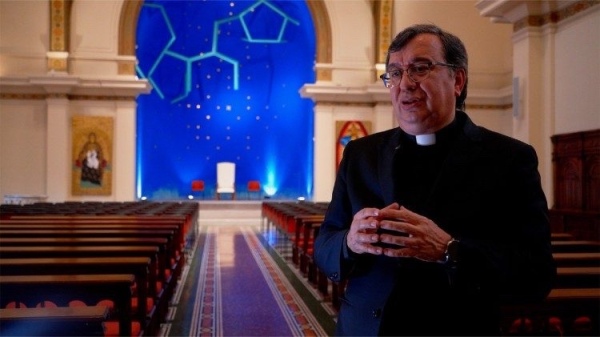
Fr Julio Fernández Techera (@VaticanNews)
At the Estadio Centenario, scaffolding is going up behind Patricia Schroeder as she speaks to Vatican News. On Saturday evening, organizers expect around 60,000 people to gather here for a prayer vigil with Pope Leo XIV. A screen outside the stadium will allow people who cannot get in to follow.
“The Pope is coming for everyone,” says Schroeder, the executive coordinator for communications for the papal visit to Uruguay. Getting that invitation out, she says, has been one of the hardest parts of preparing for the visit in a country with such a deeply rooted secular tradition.
For Catholics, Pope Leo is their spiritual leader, but Schroeder hopes people across Uruguay will also see a world leader bringing “a message of peace and hope for the whole country.”
Her team began building the communications operation from scratch about three months ago. More than 30 people now give their time to the work, and the team plans to broadcast all the Pope’s engagements in Uruguay.
The visit’s motto, “I bring you good news of great joy,” comes from the Gospel of Luke. For Schroeder, the words have a place in the invitation even for people who have never heard them read in Church.
Not far from Plaza Independencia
Pope Leo arrives on Friday, November 6, to begin his Apostolic Journey to Latin America. He will meet President Yamandú Orsi at the Estévez Palace and address the authorities, civil society and the diplomatic corps in Plaza Independencia.
At the Cabildo, he will receive the keys to Montevideo. His programme in the capital will also take him to Casavalle, a neighbourhood on the outskirts where many families face social and economic hardship.
Not far from Plaza Independencia, Father Juan González knows where he’ll be when the Pope reaches the Metropolitan Cathedral. “As parish priest, I will have the honour of welcoming him at the door,” he tells Vatican News’ Sebastián Sansón Ferrari.
There are hymns to rehearse and security arrangements to finish before bishops, priests, deacons, men and women religious, and seminarians gather for Vespers. “The work is very intense, but there is so much joy,” Fr González says. For him, the visit is “a caress from God.”
The courtyard where the rector stood
Look up in the Aula Magna of the Catholic University of Uruguay and you’ll see turquoise lines against a deep blue backdrop dotted with gold stars. The artwork, by artist Carlos Musso brings together carbon and the Southern Cross to evoke life and its origins. On Saturday, beneath it, Pope Leo will address members of Uruguay’s education community before heading to the Centenario to pray with young people.
When we meet the rector, Father Julio Fernández Techera, SJ, in the Aula Magna, he tells us where he was the last time a Pope visited. He was a student, standing in the courtyard when Saint John Paul II came out to speak to the young people gathered there. The university was three years old.
“We didn’t even have any graduates,” he recalls. Today it has around 8,000 students across three campuses.
The courtyard is now a terrace. The rector expects some 1,500 people to follow Saturday’s meeting there on a large screen. Afterwards, Pope Leo is due to step out onto the balcony to greet them and give his blessing.
Inside the university, preparations have also meant taking up a question that staff and students have been discussing for three years. What does artificial intelligence change about education? The university has held panels and invited experts to discuss Pope Leo’s Magnifica Humanitas. For Fr Fernández Techera, the question is how to use the technology ethically while keeping “the human person at the centre.”
Santiago, a 23-year-old business management student, brings up Magnifica Humanitas when we speak to him, too. He worries that the way people use AI could make everyday life less human.
When the conversation turns to Uruguay, he singles out the country’s high suicide rate as one of its most pressing concerns.
A popemobile and a loaf of bread
On Tuesday afternoon, Uruguayan manufacturer Nordex handed over the popemobile to the Apostolic Nunciature at a ceremony attended by the Apostolic Nuncio, Archbishop Gianfranco Gallone. Around 35 workers and technicians helped adapt a Fiat Titano pickup so that Pope Leo can stand and greet people along the route.
In artisan bakeries, the welcome takes a different form. A loaf created by Uruguay’s bakers’ association combines rye, a nod to the Pope’s native Chicago, with potatoes, maize and quinoa, which recall his years as a missionary and bishop in Peru.
The visit comes as Uruguay’s National Emergency System monitors El Niño and coordinates preparations for possible flooding. The seasonal outlook points to a greater likelihood of above-average rainfall in the final months of the year, particularly in northern and parts of central Uruguay.
After the visit
At the Centenario, there is another gathering before Saturday’s vigil. On Wednesday, volunteers are due to collect their shirts, receive their final instructions and pray together. About 3,600 people have signed up to help across Uruguay.
For Schroeder, the fact that so many people and communities have already come together is part of what she hopes will last after the Pope leaves.
Back in the Old City, Fr. González speaks of people who step into the cathedral from the street. Some tell him they come because they find peace there.
He has also noticed more young people and adults asking about Baptism or preparing for Confirmation. That search began before the visit, he says, and he hopes the Pope’s presence will encourage those taking their first steps towards the Church.
Francesca Merlo – Montevideo, Uruguay
Source: vaticannews.va/en