
Peruvian Church called to communion and fraternity after Pope’s visit
 In a concluding interview following Pope Leo XIV’s Apostolic Journey, the President of the Peruvian Bishops’ Conference reflects on the Pope’s teachings and tasks left to the Church in Peru, as well as the fruits the Bishops hope to achieve.
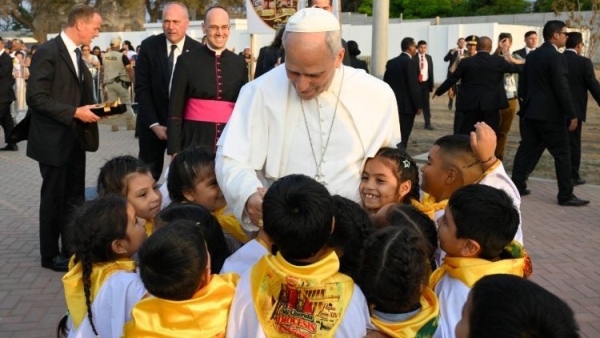
Pope Leo is greeted by children at the event closing the Jubilee of Saint Turibius of Mongrovejo (VATICAN MEDIA)
“The messages are a challenge for the universal Church, but especially for Peru, because he has spoken to us about our realities,” commented Bishop Carlos Enrique García Camader, President of the Peruvian Bishops’ Conference, in an interview with Vatican News at the conclusion of Pope Leo XIV’s visit to the country.
Q: What is the first thought of the Pope that comes to your heart at this moment?
I am home. I am among you, sharing my story because I also know your story. The first thought: we are brothers and sisters.
Q: During his visit, Pope Leo spoke about very different realities: social inequality, political instability, violence, corruption and the exclusion of the most vulnerable. What do you consider to be the most important message the Holy Father leaves to the country now, in the face of all these situations?
I believe that the Pope, first of all, knows our history; it has not been told to him. And secondly, he reaffirms it very clearly through his Petrine ministry. It is not so much about telling us that he knows us, but rather inviting us to three things: to listen to one another. No matter how difficult the problems may be, we must begin by listening to one another, by knowing how to pay attention to one another, and by not being indifferent to the pain of others.
Pope Leo XIV greets those gathered outside the Apostolic Nunciature in Lima on the morning of the last day of his Apostolic Journey to South America. He is scheduled to visit a ...
And thirdly, dialogue, which is important. I would say these are the three main things needed to resolve all those difficulties arising from distances and differences, because Peru is a multicultural country in its languages, its customs and also its ways of expressing itself. Even its capitals and cities have a thousand different ways of being, because we are so different.
Let me tell you clearly: I live in Lima, but on the outskirts. And in those outskirts, within those 80 kilometres, there are people who have never come to the centre of Lima, who live in the surrounding areas and are unaware of everything that happens in the centre of Lima. I say this because I have spoken with them.
It seems so strange to me: so close and yet so far away, and with a different language, because, amid misery and poverty, there is an attitude of dialogue; people talk to one another.
And there is a particular district that came into being around the time Pope John Paul visited. He found himself in a sandy area and said: “There is the summary of all Peru.” In other words, all the realities of Peru are present there. He said a great phrase: “Hunger for God, yes; hunger for bread, no.”
In that reality, we must learn to live, believe, love and serve. Three important things.
Q: Of all the events we experienced over these past few days, was there any event that caught your attention and touched your heart deeply?
All of them. All of them, because each one speaks of a reality of Peru. And what we must learn is to add things together, not to look at ourselves as regions, but to look at ourselves as one country.
I believe this is the Pope's profound message. Let us feel that we are brothers and sisters to one another, not indifferent to one another. Not like someone who says: “That happens in the mountains, it does not happen in Lima.” Or: “That happens in the jungle, it does not happen in the mountains.” That is not true.
Whatever happens to a brother or sister, we must all feel it as our own. And whatever happens on this Earth must also be felt by the people. And whatever is done to the people is done to our brother or sister. This is what he emphasized so strongly in Pucallpa.
Q: Your meeting as Bishops with the Holy Father was also something important for the pastoral ministry of the Bishops.
Three things.
First, he changed the way he addressed us when he said: “Your Excellencies, Your Eminences, brothers and sisters.” That gesture awakened something in all of us. It broke, as they say, the glass barrier, that distance. He wanted to tell us something important: to highlight the figure of Saint Turibius as a model shepherd, so that we may be close, so that we may draw close to people, and not remain distant from them.
There is no distance for a shepherd. Whenever one knows whom one is going to meet, distance is overcome. And there is something important: becoming close to the other person also in their vulnerability, in their different realities.
He also spoke about human miseries within the Church and emphasized to the Bishops the need to touch our lives and to truly bear witness to the Gospel.
And he said something very clearly: that among us too there have been people who, with their consecrated lives, have caused scandal within the Church.
I believe that the Church and the Bishops must also reflect on the word forgiveness, on behalf of all pastors or of those people who may give cause for scandal or pain.
And thirdly, something important: we must not forget that we are not alone and that we must not work alone, each one in his own diocese, whether beautiful, small or large.
We must be supportive of one another and bear witness to working in communion and fraternity. We must break away from that attitude of “my borders and your borders”. There must be greater fraternity, but also cooperation among the Bishops and their respective jurisdictions. That is what I would highlight.
Q: The Pope has called for dialogue, unity and for words and hearts to be poured out. Peru has been experiencing a profound political crisis for years. What role can the Episcopal Conference play in helping to overcome this division without itself becoming a political actor?
I would like to highlight three things.
First, the period before the Pope's arrival. A series of opportunities for encounters with many people were created. But secondly, also with many people who feel that they are not being heard.
Sometimes one discovers that they believe we are the reason why they are not being heard. But I do not dwell on what they said; I focus on their need to feel heard.
That is why an Episcopal Conference must be open to dialogue and listening, whatever the reality in which people wish to be heard, whatever the need, pain or suffering that a person may have in relation to what they understand, see or have felt on the part of the Church.
I believe that the first attitude we must have is that the Pope's present message makes us face the reality of the absences that have existed in our episcopal ministry.
And thirdly, to establish a programme of trust, of a safe Church, which provides security and evangelizes.
Q: In Pucallpa, the Pope spoke about violence against women and minors, sexual abuse and the silence that often conceals complicity and impunity. What must the Peruvian Church do now to be credible in this area and strengthen people's trust?
I believe that what is already being done through the listening commissions and the human dignity commissions must be expanded; it must become more visible.
After listening to four testimonies in Lima, Pope Leo addresses challenges facing families, women, workers, and a culturally diverse society, and he calls for greater solidarity ...
It can no longer involve only a few people. Rather, we must seek to involve professionals and qualified individuals, because when faced with a certain difficulty, it is not enough simply for me to listen. There must also be a definite and accurate response. In other words, one that points towards the truth, but also towards a solution.
Therefore, I do believe so. The Pope, in the face of this violence, which in some cases seems to have become commonplace, draws our attention to the fact that we must work much more on the basis of human dignity.
But this is not based solely on a human concern. The Gospel itself already tells us: “What have you done with your brother? Where is your brother?”
This is the importance that we must feel through our faith: the responsibility to look after others and their problems and the different realities must lead us, through faith, not to remain indifferent to human trafficking, drugs, alcoholism, institutional indifference and the lack of promotion of integral human development.
It is an education that often leads into a void, a lack of healthcare, and along with this, all the corruption that exists.
I believe we have hope that Peru will follow a better path, but we cannot do it alone. And the Church can play an important role within its jurisdictions and as an Episcopal Conference, as brothers and sisters.
Q: The Pope has called for a Church that walks closer to people, especially the poor, indigenous peoples and those living in the most remote regions. What concrete consequences do you think the Peruvian Episcopal Conference will draw from this visit?
First of all, rather than speaking personally, I would like to express my thought as that of the entire Conference. This will lead us to hold an Assembly on the Pope's homilies and the pastoral challenges he has left us.
I would like to listen to my brother Bishops. We are living in a synodal time. This time means listening and discerning in order to know which direction to take.
But as far as I am concerned, I would say that the Conference is renewed by the Pope's presence in Peru.
The messages are a challenge for the universal Church, but especially for Peru, because he has spoken to us about our realities.
What must we do to evangelize? It is not so much about competing, because sometimes we believe that when a priest or Bishop speaks about these problems, people say: “He is a politician.” But when we have to practice charity, they say: “He is a saint, a good person, a generous person.”
We must therefore bring these two realities together, because both are evangelical: proclamation, denunciation and the witness of one's life.
I believe the challenge is great, but I do not want to anticipate what the Conference is going to do, because that would imply a lack of respect for the Conference itself, which is made up of more than 50 Bishops.
Q: A thought now about Chiclayo. But first, who was Father Roberto? Who was Bishop Prevost, and later Leo?
As an Augustinian missionary, he was a man who was close to people, who knew how to listen a great deal and walk with them.
As Bishop of Chiclayo, he was a super-active man, very practical and very technical, capable of saying: “This must be resolved today, not tomorrow or the day after.”
That is why, in the different realities, he knew how to remain close to people, because he ate with them. He was close to them in their activities, not only religious but also social, in the sense that if it was someone's birthday, he would go and meet them.
It was not so much because he did the same things as others, but because he was able to engage in dialogue with the other person, with people, in their everyday lives.
Pope Leo XIV crowns the Immaculate Virgin at the Cathedral of Chiclayo and entrusts his life and ministry to Our Lady, in the same place he began his episcopal service as the ...
Who was Father Roberto? Who was Bishop Roberto? He was a man attentive, through his gaze and his listening, to responding to the needs of others.
Perhaps not through major activities, but from person to person, which is something important.
And what we see today is the sum of many people, something that must be highlighted. It was not an activity he carried out for everyone, but an activity he carried out with a name and surname for each person he encountered along the way in Chiclayo.
Secondly, in the face of adversity, he did not withdraw into himself. He went out to meet adversity.
And as he himself says: “In the face of adversity, we must neither retreat nor hide. We must face it, but with the strength of Christ.”
Clearly, with that strength of Christ. He already had it, and he still has it.
And I believe that this is how he faces things.
Some say that it is an American strength, a practical one. Perhaps that is so, because he cannot deny his own nature.
But that nature is enriched by the witness and life of the simple Church of Chiclayo, in its customs, in its way of treating people, in its faith and in the structures he was called to work with, structures that had already been established.
Because he did not arrive in a diocese that still had to be built; it was already established. But he gave it a new brightness, with his professional wisdom and his preparation as a theologian and canon lawyer, which gave him great stature.
He could engage with young people, he could face everyday reality without being surprised by it, nor seeking to stand out, but simply being one among the others.
He is a brother. I know him better through this work than through the Episcopal Conference, where many people speak and he listens. His contributions were precise.
Roberto, what does the law say? What do the statutes of the Conference say?
He knew the statutes and canon law by heart.
We also had the opportunity to work together on the commission for listening to victims.
He had an attitude of listening and was precise in finding solutions that were within his reach.
He drew up some regulations, some guidelines for the Conference, with which we began to understand how we should proceed, or what process we should follow, in assisting a victim.
We began that journey with him, which today, thanks to Pope Francis and the present times, has brought us to the point where we must put on roller skates, because we can no longer walk in shoes, but must wear roller skates, because reality demands it.
The problem may have arisen yesterday, but the solution must be today, not tomorrow.
Q: We have a Peruvian Pope.
Of course we do. A Pope who belongs to the universal Church, but with a Peruvian flavour.
Q: When you, as President of the Peruvian Episcopal Conference, welcomed the Pope, who also knows this country and was part of the Peruvian Church, what did this mean to you?
First of all, a very great surprise.
Of course, the wishes are there. We know that it is the action of the Holy Spirit who chooses at that moment.
It was a great surprise. A great surprise that brought immense joy. At first, we did not know what to do with such a beautiful gift.
It is as if someone gives you something so great that it goes beyond your own ability to comprehend it.
I did not know what all of this meant. Little by little, we began to process it.
Although he belongs to the universal Church, Peru began to stand out from that very afternoon, with the surprise of a Peru that discovered that the Pope had been in Peru, that he had become a shepherd in this Peruvian land and that he had assumed Peruvian nationality by his own decision.
It is an undeserved gift, but God, in His infinite mercy, has looked upon Peru in order to lift our spirits amid suffering, pain and so many circumstances that we experience in life: deaths, brothers and sisters divided against one another, situations that are difficult to overcome.
That is why the work of reconciliation is a task still to be carried out; it has not yet been accomplished.
That is why there are often feelings of confrontation or, at times, feelings of such great sensitivity.
Do they need to be healed? Yes.
But God, in His infinite mercy, has given us a gift, and that gift is Pope Leo.
And he tells us: “You are not alone. I am with you.”
Q: Does Peru already feel nostalgic for Pope Leo?
More than nostalgia, joy. A joy that gives us security, that gives us confidence, because I know that we have not lost him, but rather that we have been enriched as a country and as the People of God.
Silvonei Protz and Christine Seuss – Lima
Source: vaticannews.va/en