
Pope: Church’s understanding of Apostolic Tradition deepens coherently
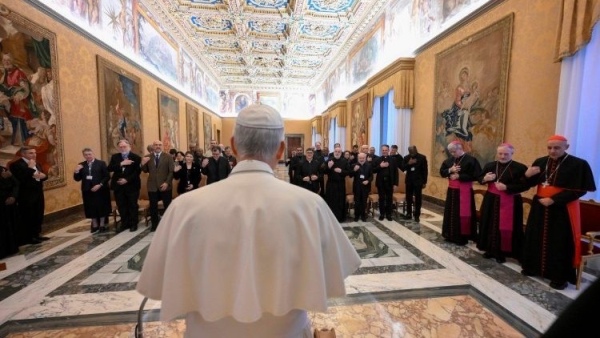 At an audience with the International Theological Commission, Pope Leo XIV upholds the continuity of the Apostolic Tradition, which seeks inculturation and deepens our understanding of the realities and words handed down.
Pope Leo XIV greets the International Theological Commission (VATICAN MEDIA)
Pope Leo XIV met on Wednesday with members of the International Theological Commission (ITC), as they hold the first Plenary Assembly of its 11th five-year term.
Recalling that he recently renewed the ITC’s membership with various appointments, the Pope thanked the commission for its work of understanding the faith along the path laid out by the Second Vatican Council.
Their work, he added, assists the Church in discerning the “unprecedented challenges and opportunities that arise in different cultural contexts.”
Pope Leo pointed to the two themes which the Assembly seeks to examine, which are Apostolic Tradition and the cultural forms through which the faith is transmitted.
Apostolic Tradition “goes to the heart of the Church’s identity and mission,” he noted. “The Second Vatican Council teaches that ‘the Church, in her teaching, life and worship, perpetuates and hands on to all generations all that she herself is, all that she believes.”
Quoting Pope Benedict XVI, Pope Leo said Tradition is “the permanent presence of the Saviour who comes to meet us, to redeem us and to sanctify us in the Spirit, through the ministry of His Church, to the glory of the Father.”
The Church, added Pope Leo, must always proclaim and bear witness to the presence of Jesus Christ and hand on the faith to successive generations.
“Because holy Tradition is always living, our understanding of this reality deepens continuously and coherently,” he said.
At the same time, Catholics must reject forms of “emancipation that would authorize a break, almost a pseudo-liberation, from what… the Church has authoritatively taught and professed.”
However, he noted, the Second Vatican Council recognizes a growth in our understanding of “both the realities and the words that have been handed down.”
“This entails a development of the principles that animate the teaching of the Magisterium, without any rupture in that teaching,” said Pope Leo. “Consider in particular such matters as war, slavery, and the death penalty.”
Pope Leo XIV went on to point out that the living nature of Tradition entails a dynamism that calls the Church to listen attentively to the Holy Spirit in the realities of our time.
Quoting Pope St. John Paul II, the Pope noted that new challenges of history push us to discover that “‘not infrequently the Spirit of God, who ‘blows where He wills’, brings forth in universal human experience, despite its many contradictions, signs of His presence that help Christ’s disciples themselves to understand more deeply the message they bear.”
“The inculturation of the faith is indeed indispensable to bearing consistent witness to it from generation to generation,” said Pope Leo.
Inculturation, he added, invites the Church to take into account people’s distinctive characteristics, cultural settings, and social situations.
As the Church faces new challenges of inculturation, the International Theological Commission can assist by reflecting on the underlying theological principles and offer practical guidelines to help interpret and promote the proclamation of the Gospel.
“This also means appreciating that ‘in popular piety we can see how the faith, once received, becomes embodied in a culture, and is constantly passed on’,” he said. “Popular piety itself shows how the inculturation of the Gospel ‘makes culture itself, in turn, a means of transmitting the faith’.”
In conclusion, Pope Leo XIV invited the International Theological Commission to reflect deeply on the “living and life-giving Truth that has the face of Jesus Christ,” as they explore the Apostolic Tradition and the process of inculturation of the Gospel.
“This,” he said, “is precisely why that Truth can continue to be handed on throughout history and embodied in successive cultures.”
Devin Watkins
Source: vaticannews.va/en