
Pope: Healing is an important part of my ministry, overcoming polarization
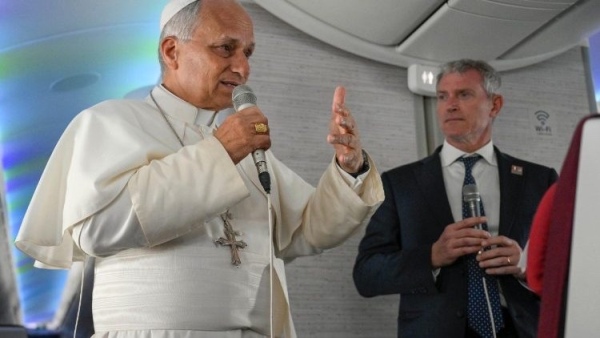 On the return flight from Latin America, Pope Leo XIV speaks to journalists about how the United States shaped him and calls for dialogue after the US midterm elections. He also discusses his recovery from lung surgery and reaffirms his commitment to Church unity and Pope Francis’ decision in Traditionis Custodes.
(Vatican Media)
If he could give his journey to Latin America a name, Pope Leo XIV would call it Magnifica Humanitas, after his encyclical. It was, he said, “a true experience of meeting people, recognizing the gifts in the different cultures, the different peoples, the different cities, and rural areas that we visited,” while “recognizing that the great gift of humanity is all the greater because it is God’s creation.”
Speaking on the flight from Lima to Rome, Pope Leo shared his enthusiasm for his sixth Apostolic Journey, which took him to Uruguay, Argentina, and Peru. He thanked the 82 journalists who had accompanied him on the pilgrimage through the three countries. “Thank you for the work you’ve been doing,” he told them. “I hope I didn’t tire you out too much.”
“It was, I think, a wonderful trip in many ways,” the Pope continued, speaking in English.
Addressing the journalists in Spanish, the Pope expressed his gratitude to God and to the peoples, communities, and countries that welcomed him. “There is great value in these human and religious experiences, in this experience of devotion and faith that we have been able to share over these days.”
As is customary on the return flight from an international journey, Pope Leo readily took questions from journalists representing different language groups. “If anyone wants to ask a question, I’m willing to try to answer several,” he joked.
The questions touched on his health, the operation to remove a tumor, and the stamina he had shown during the trip, as well as Argentina’s economic and social difficulties, his meetings with President Javier Milei, and possible future journeys, including one to his native United States.
Journalists also raised major issues facing the world and the Church, including a possible revision of the motu proprio Traditionis Custodes.
Below is a working English transcription and translation of the press conference:
[Juan Carlos Paullier, Zorrilla Media:] How are you feeling? Were you surprised by the stamina you showed during this journey?
[Pope, in Spanish:] Others were surprised by me. I want to give thanks to God. The operation was fairly demanding, and it’s been a little over a month, as everyone knows. The trip had already been planned, and from the outset I wanted to see it through. So, with God’s help and, I believe, the power of prayer—I received messages literally from all over the world—with some determination of my own and with the help of the doctors, I saw that it really was possible. I’m not at 100 percent, but I’m doing quite well. And stamina is one of the gifts the Lord has given me.
Turning to Uruguay, which already seems a long time ago, one of the things you said was that smallness should not be confused with insignificance. What concrete example can the Church in Uruguay offer other communities? Why did you decide to visit a country like Uruguay, and what do you hope your visit will bring to Uruguayan Catholics and to society as a whole, which is so secular?
[Pope, in Spanish:] It’s November, and Advent and Christmas are drawing near. I think, for example, of the Nativity scene, of those small villages where Jesus would arrive with His message, and of how a small community can do great things. Those things may be modest in themselves, but faith begins like a mustard seed.
In Uruguay, we all saw the tremendous response of the Catholic community, and not only them, and perhaps some people were genuinely surprised. A providential coincidence in the scheduling also allowed us to take part in the celebration of Our Lady of the Thirty-Three, a very important feast in the history of Uruguay’s Catholic community.
All this helps us see that even in a country considered secular, where many people no longer actively practice a faith or religion and where participation may be limited or even absent, the Church, the faithful, Christians, have a great deal to say. The response over these days was wonderful, and I think it left a mark.
[Elisabetta Piqué, La Nación:] Thank you, Holy Father, for this wonderful trip, and congratulations, because we’re exhausted. During your time in Argentina, you met President Javier Milei a couple of times. Can you tell us how those meetings went and what you felt was the most important message for Javier Milei’s government? And there’s another important question that has been left hanging. You knew Pope Francis well. Why did he never go to Argentina?
[Pope, in Spanish:] I won’t answer the second question because I can’t presume to read Francis’ mind, even though I worked with him and knew him for the last few years and a little longer. But why not leave it to the mystery of eternal life? We can ask him in eternal life.
I had already met President Milei in Rome, when he came to the Vatican. He and Francis held very different political views, yet they seemed to get along. I insist that the message I want to convey, the message I want to bring, is not political.
In some countries, people try to push me to the right or to the left, whether or not they criticize me. I speak about Magnifica Humanitas, and that’s what I spoke about with President Milei. We talked about respect for the human person, and I encouraged him to pay greater attention to those most in need in Argentine society.
Yes, we talked about economic issues and some of the difficulties the country has been going through since he took office. Above all, there was a kind of mutual understanding, so to speak, in recognizing the value of life and the value of the human person at every stage of life. We have to find ways to work together on that.
That was the direction our conversation took. As you could see both when I arrived and when we said goodbye, he showed an openness to listen to that message. In that sense, I think it was very positive.
[Pamela Francescato, Canal 5 Noticias:] Before you arrived, Argentina was going through difficult, dark times in many respects, and it still is. Since you left, after hearing your words, you’re all anyone in Argentina is talking about on television and radio. You’ve left us with a very beautiful and powerful memory. Society needed your voice, your magnificent humanity, and to hear that we should go on being human. What advice can you give us? What is your vision?
[Pope, in Spanish:] I think we’re all realizing how much we’ve allowed ourselves to be swept along by algorithms and by polarization that hasn’t happened by chance. In many situations, it’s been deliberately stirred up. And I think you have a very important role in helping everyone overcome this kind of polarization and say, let’s look at what happened in Argentina over the past few days. How was it possible for all of us, right and left, to be out there in the streets celebrating and enjoying something much bigger than a political argument?
I personally believe very strongly that the message of Jesus Christ—with great respect for those who aren’t Christian and choose another path—invites us to build bridges and seek reconciliation. In this way we can rediscover aspects of our humanity that go much deeper than the things that divide us and give rise to hatred and polarization.
I’d like to think the visit at least helped awaken in many people’s hearts the awareness that we can change our mindset, that we can think differently. There will still be differences of opinion, but things don’t have to get to the point where people use such violent language and create divisions even within families.
We can talk to one another, love one another and come together. So, let’s hope that, by sowing seeds of hope again and offering a message of unity amid difficulties and differences, people will seek solutions that serve the common good, the good of the people.
[Sergio Rubín, Clarín:] Argentina had a large middle class that suffered a staggering social collapse, with effects as widespread as if there had been a war. The country is now going through a process of economic adjustment. What can be said about this in light of the Church’s social teaching? People are making a great effort and they’re suffering. Argentina has so much wealth and talent, yet it still hasn’t managed to get back on its feet. How can we put an end to this immoral situation?
[Pope, in Spanish:] Without giving an economics lesson, there are international issues today that have contributed to a situation so serious that it is causing many problems for the middle class, to say nothing of the poor. Here too, I think we have to encourage everyone, citizens and political leaders alike, to see how they can work together to rebuild and improve living conditions for everyone. In some cases, that means international cooperation and finding solutions to difficulties that are causing, let’s say, serious conflicts or economic repercussions for people.
We all have to look to the common good. With support, small businesses can often do more to create jobs and help sustain a middle class. It’s very important to encourage individuals to find a way to live with hope, and to encourage those with greater resources to pursue what is good for everyone.
We have to work in a world where fewer and fewer people have more. The Church’s social teaching also addresses this accumulation of wealth and asks how it can be redistributed a little more effectively, indeed, much more effectively, so that the middle class doesn’t shrink or disappear and can grow stronger, and to reinforce the working class. That means encouraging people and movements to work together so they can live with greater dignity.
[Fátima Saldonid, Peruvian public television:] Holy Father, you know we’re very affectionate, with big hugs and big gestures, and we were a little worried when we saw the footage of someone throwing a rosary to you. But you know it was all done with love, because everyone wanted to be close to you. You said that in your work in Peru you learned how to be a bishop, and that on this journey you learned a little more about being the Successor of Peter. What moved you most, and what will you take from this experience into your future work in the Church? There’s something other people don’t understand. You’re our father, but our dad has gone away. When will you come back?
[Pope, in Spanish:] Well, let’s leave that last question aside, because I don’t know where I’m going next year, let alone further into the future. I’ll take the opportunity to say that preparing for a papal visit is an enormous undertaking, and I thank all the communities.
Lima has more resources and did a great job. Pucallpa has fewer resources but a great deal of warmth in many senses, and they too worked to make yesterday’s events happen. Then there’s Cusco, Chiclayo… I really want to thank everyone who worked on this project. It wouldn’t be fair to them to come back too often, so now we’ll let them rest a little.
The affection of the Peruvian people, including that of the person who, with great faith, simply wanted to give me a rosary, is something carried in the heart… perhaps in the eye as well… These are things that leave a mark on a person’s life. They show that there really is enthusiasm here, that there is deep faith and a desire to receive the Lord’s blessing through a servant, through the Pope.
That closeness is itself a message that goes both ways. It means being able to share our faith with joy and to give a blessing. It’s a little like the woman in the Gospel who only wanted to touch Christ’s cloak to receive his blessing. I was passing by in the car and people wanted to touch the Pope’s window. They were trying to get past the National Police cordons because they wanted to live, feel, and experience that faith.
I try to be close to them, and I thank God for the energy He gives me. I also receive something from them. This enthusiasm, this faith, this devotion is truly a gift from God, shared with everyone, with the whole world, which has witnessed what we experienced. I give thanks to God. There are no other words.
[Carlos Villareál, RPT Notícias:] One of the most significant aspects of your visit was that you came to Peru at a very difficult time for us. In your address you mentioned the current violence, El Niño and the rains in the north of the country, which you know very well. How do you think Peruvians, believers and non-believers alike, can sustain the spirit of unity, faith and hope that your visit has awakened in us? And allow me to ask you something else. I know you met people in Peru who reported that they had suffered appalling treatment at the hands of members of the Church. How did you feel after speaking with them?
[Pope, in Spanish:] In a sense, at least part of the answer is the same for both questions. As far as I’m concerned, I’d be happy to visit every country in the world if the Lord gave me enough time, but there’s only one Pope. He serves as the Vicar of Christ, and the Church lives locally through the bishops, who are its pastors.
Part of the message I shared with the bishops was that they themselves should carry forward the experience of faith we lived through in those days. I told them it’s their turn now to hold on to the gifts we shared and carry them forward, so that this experience of joy, devotion and faith can continue to grow.
As for the victims, this certainly isn’t the first time I’ve spoken with victims in Peru or in other countries. The Pope can’t listen to every single person throughout the world. So, this too is a gesture that expresses a desire to be close to victims and to help them find a path that, perhaps in small steps, can lead them towards genuine healing.
At the same time, it’s a commitment to keep working on prevention so that such things never happen again. It’s also an appeal to bishops and pastoral workers in their dioceses. Those of you closest to these situations must fulfill your duty to accompany the victims. You yourselves must take responsibility for accompanying them and helping them obtain justice.
[Fabio Marchese Ragona, Mediaset:] It was a wonderful visit, very intense, with a packed schedule. Some of us survived, but we came pretty close to…
[Pope, in Italian:] I can see a lot of tired people back there. I don’t know what’s going on! (Laughter)
We saw you give so many speeches, and it almost seemed as if you didn’t feel tired. That made us think about how suddenly you had to go into hospital. We wanted to understand what that experience was like for you as a patient, whether you’ll need further check-ups or treatment, and whether anything will change in your life as Pope.
[Pope, in Italian:] The initial news was a surprise. I had no symptoms and felt well. I was having the routine annual check-ups I’ve been having for many years when they found what first appeared as a shadow. After further tests and a biopsy, they saw there was something there, that it was a tumor.
As I said earlier, I wanted to make this visit, so I said, let’s do it straight away. By the grace of God, I was at peace. I felt it had to be done, so let’s do it. I trust the doctors we have and the medical care we receive, and we went ahead.
Thank God, as you know, everything went very well. The tumor was entirely contained in the part of the lung they removed. It was confined to that area, so there’s no need for further treatment for it. As a precaution, I’ll need to stay on top of the check-ups, as I do with the annual ones.
How did I feel? I have a brother, and this is public knowledge, who is going through a much more complicated situation right now. We’re going through it with a great deal of trust in the Lord. Perhaps it can be a sign to people who are suffering and may understandably be very frightened.
Get your check-ups. Prevention is very important. Look after your health. When treatment is needed, try not to be too afraid and go ahead with it. Thank God, with the strength of so many people’s prayers, it went very well in my case, and I’m here to bear witness to that.
[Gerry O’Connell, America Magazine:] This was a wonderful trip. And seeing you in Peru, I think your heart is in Peru and your body might be in Rome. But my question: Yesterday at Pucallpa, speaking at the port to the missionaries and to the Amazonian leaders, you said to the missionaries, your vicariate is larger than many countries. You have only 25 priests. Now, Holy Father, you went to Peru in 1985 as a missionary. If I understand correctly, the Augustinians in the States responded to Pope John XXIII’s appeal to send priests to Latin America. There were not sufficient priests. You’ve been there 20 years, now you return as a missionary pope. You still see the situation as a lack of priests there, and also in the United States they’re closing churches. We see that at the Synod on the Amazon, there was a big discussion. There was an approval of a motion to ordain viri probati, mature married men. We see that in the consultation for the Synod on synodality, this issue raised up. Is the Holy Spirit not saying something to the Church through all this? And secondly, my question, is Pope Francis in his Querida Amazonia, didn’t say no or didn’t say yes to the question proposed by the Synod on the Amazon about the mature married men. My question: Is this an issue that is still open under you? Are you still considering it? I mean, you’ve been a missionary, you’ve seen the reality.
[Pope, in English:] So let me say, first of all, just to add some perspective, beginning with where I started my missionary activity in Chulucanas.
When I first went to Peru, there were, speaking of the Augustinians, perhaps between 15 and 20 American Augustinians and two Peruvians. Today, of the Augustinians in northern Peru, I don’t think there are any. Maybe one, but I’d have to think out, I don’t think there are any Americans.
But there are 35 Peruvians. So, the Spirit works in many ways, and certainly in areas where vocation, promotion, formation is carried out in ways that are, if you will, productive. The door is not closed to thinking that there could be more priests and Peruvian priests in the future to also attend to these missionary areas.
So, there are challenges there that are being faced, for example, in the Amazon region, where the question of vocations has been more complicated for many different reasons. But where, for example, there are seven apostolic vicariates in Peru. So, yesterday we were in Pucallpa. Pucallpa, Puerto Maldonado, and Iquitos would be three of the vicariates that have more vocations today. Other vicariates have far fewer. There’s much work to be done.
One of the solutions that has been proposed for consideration is what you are speaking about. It’s not the only solution, but it’s a solution which, in certain areas of the Church, can cause division, because there is not universal, if you will, acceptance of that concept. And, as I also have made clear numerous times in this brief year and a half, or whatever it is that I have been Pope, that one of my priorities is first to promote unity and communion among us as members of the Church.
To promote an idea which the Holy Spirit may continue to suggest (but not just to me, the Pope doesn’t change Church doctrine), we all have to listen. The bishops have to listen. It may be in the future that some things will change. However, for right now, what I believe an important part of my ministry of the Church is to heal, bring people together, similar to what we were talking about, polarization on political issues in some countries within the Church. To say, first, let’s come together. Let’s consider what we believe the priorities need to be, and then we’ll see how we walk forward from there.
I’m very well aware many people are not in agreement with that approach. That’s alright. I’m here, and that’s what I am offering in terms of part of my ministry. And I suppose that’s enough right now, because the whole question about married men as clergy is complicated. There are others who have other proposals, as we know. But all these things are going to take time, and we will go with that as the Lord moves us.
[Sylwia Wysocka, PAP:] You spoke often during the journey about your operation. Your predecessors signed conditional letters of resignation in case they were to fall into a coma. Have you signed a letter of that kind as well?
[Pope, in Italian:] No. For now, thank God, I don’t see a need. Canon law already has several provisions that touch on this issue. It’s in God’s hands, as I said before I was elected Pope. I trust in him. I think I may do it eventually. For now, though, I don’t see the need. Thank you.
[Valentina Alazraki, N+ Televisa:] Over these past few days, you’ve said several times that Peru is your home. You’ve told us what its people gave you and how they changed you. You’re in part the person you are because of what you experienced in Peru. But you also have another homeland, the United States, where you were born. What was it about the United States that shaped you? What did the United States give you? And I know you’ll say you may not have precise dates, but could we imagine a trip to the United States, “from Chiclayo to Chicago”?
[Pope, in Spanish:] A few minutes ago, I said that the journeys for 2027 are still being planned. The only one that’s been confirmed is Korea for World Youth Day. Beyond that, there are several possibilities and we’re looking at them. That’s where things stand for now.
In many ways, I’m a gringo, a North American. Before the conclave, there was an article in one of the newspapers saying that Prevost was “the least American of the Americans.” I think that, among other things, when I say something, I say it plainly and directly. I tell it like it is. Talking about my health, or even saying, “Well, I’m going through this,” wouldn’t be typical in many countries and cultures. It’s a little more common in the United States. I don’t want to stir up more questions here, but my deep belief in democracy and democratic participation is also part of being American. The way I live my faith was, of course, deeply influenced, let’s say transformed, in Peru. I grew up in a multicultural family in the United States where we also lived our faith. So, I think many things come into play, including having been shaped by that culture.
You know how excited Mexico is to welcome you…
[Pope, in Spanish:] Thank you very much!
You visited Our Lady of Guadalupe in Uruguay. Can we dream that you’ll come to Mexico as well?
[Pope, in Spanish:] Of course. I’ve been to Guadalupe several times. You can dream, but don’t wake up too soon… I’ll go, I’ll go.
[Jean-Marie Guénois, Le Figaro:] Holy Father, after this very impressive journey, which has been tiring for you, and came after your operation of 13 October, will you be reconsidering your priorities for the coming months? And if I may, also ask also a few, three little questions on three specific, very specific matters. Can you confirm that the Holy See is preparing a document on spiritual abuse that foresees canonical sanctions? Are you considering making the Motu Proprio Traditionis Custodes more flexible? And will you soon be appointing your first new cardinals?
[Pope, in English:] In reverse order. No comment about future cardinals. There’s still enough of them there. I think the number is about 116 currently. We’ll eventually get around to that.
Spiritual abuse is a very serious topic in the Church. It is being studied in the Vatican. There’s not an immediate document as such to be published. Well… yet. But the concept itself, the need to be able to address some of those issues canonically, which is one of the problems because in order to exercise justice, you have to have a, if you will, a codification or a juridical expression of how to apply that. And that’s a very vague concept still. Although we all probably could describe either specific cases or kinds of instances where that has happened.
So, we’re studying that and working on it.
Traditionis Custodes is the decision of Pope Francis and we will continue to follow that. Traditionis Custodes includes possibilities of dispensation or of allowing the Tridentine Mass—or the Vetus Ordo Mass—to be celebrated.
And so, again, for the unity of the Church, the vast majority of Catholics around the world, we celebrate the rite of Vatican II, of Paul VI, and we will continue to do that. And there is an avenue available for those who wish to apply for the dispensation.
[On his priorities, ed.] I don’t feel like I need to adjust them, thank you, but things will continue as we’ve been doing, basically.
[Giacomo Galeazzi, La Stampa:] You voted in the midterm elections. What do you expect now, both in your country and abroad, at a time when hybrid warfare and cognitive warfare are spreading around the world? We’re feeling the effects in Italy too. Do you expect more moderation or more polarization after the midterm vote?
[Pope, in Italian:] I can only repeat what I said a few minutes ago. I would like to see a greater capacity for dialogue, more bridge-building and reconciliation, less acrimony, fewer wars and less division. I know that this too is a dream, but I know it’s possible. So, we’ll see…
I’m not making a political comment. I’m promoting the Church’s social teaching and hoping that some people will listen. Let’s always seek to promote dialogue and the ability to listen.
Vatican News
Source: vaticannews.va/en