
Pope Leo and synodality as a ‘constitutive dimension’ of the Church
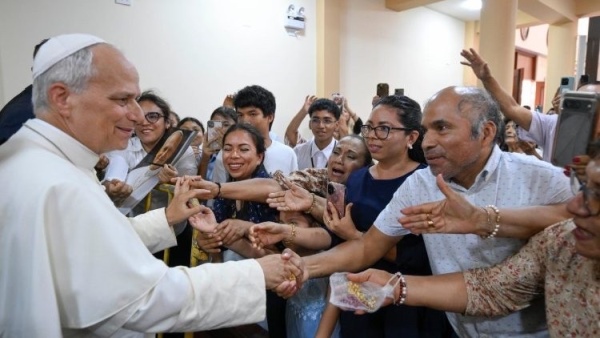 Our Editorial Director reflects on Pope Leo XIV's address to the synodal teams of Peru, as he visits Chiclayo, saying it sums up the Pope’s vision of synodality: walking together, listening, discerning, and participating in the mission in a spirit of shared responsibility.
Pope Leo greets the faithful of Chiclayo (VATICAN MEDIA)
There are speeches which, even when brief, can be programmatic and set a course for the future. The address delivered by Pope Leo at the Shrine of Our Lady of Peace, in Chiclayo, on November 13 during his meeting with the clergy, men and women religious, and the synodal teams of the diocese and other regions of Peru, is certainly one of them. Its significance is destined to extend well beyond the borders of this South American country.
First of all, through his words, the Successor of Peter reaffirmed that synodality is a constitutive and integral dimension of the life of the Church, making it clear that it cannot be dispensed with.
Synodality — so dear to Pope Francis, who in the final years of his pontificate wanted it to be discussed and explored in depth at every level of the Church — is therefore not something alien to the ordinary life of Christian communities.
It cannot be reduced to a mere slogan, nor can we imagine living it out in a purely functional manner, introducing practices borrowed from politics which are foreign to ecclesial life itself.
Nor is it yet another bureaucratic burden to be discharged, applied in words alone, without anything actually changing in the way communities live their lives.
If synodality is a constitutive and integral dimension of the life of the Church, then we are called to rediscover and revitalise something that belongs to our tradition.
Here in Peru, for example, as Cardinal Carlos Castillo Mattasoglio recalled in recent days, it was Saint Turibius of Mogrovejo, Archbishop of Lima in the sixteenth century, who “introduced into history this profoundly Christian way of convoking the Church, especially through synods and councils.”
Pope Leo XIV first presented the essence of synodality in these words: “walking together, listening, discerning, and participating in the mission in a spirit of shared responsibility.”
The key to everything is precisely “mission”: the Pope linked it to Baptism, the foundation of Christian identity, reminding us that this sacrament comes before “any service, office, profession, or ministry.” It makes us all children of God, sharers in the priesthood of Christ, and co-responsible for evangelisation. All of us.
In his address to the synodal teams in Chiclayo, the Bishop of Rome made it clear that authority in the Church must be exercised as service, discernment, and the fostering of charisms and initiatives. Above all, he emphasised that “the participation of the laity is not a concession” made to them by the clergy, but an expression of their baptismal dignity.
Insisting on the missionary nature of the Church, the Pope added: “the first witness that any Christian community must give is the fraternal love that exists among its members,” because there can be no mission without communion. The proclamation of the Gospel is intimately bound up with communion that is lived and witnessed. Jesus said, “By this everyone will know that you are my disciples, if you love one another.”
A community in which relationships marked by fraternal love are reflected, and which lives out shared responsibility, is itself the first form of proclamation, the first form of mission. From this missionary perspective, synodality represents the concrete way of living and expressing the communion that unites us, because Christ’s words can be brought to bear on every aspect of Christian life.
Synodality is not a parliament or an opinion poll, but a spiritual and communal journey that springs from listening to the Holy Spirit. It therefore has its origins in participation in the Eucharist, in prayer, and in adoration.
It is “a communal and pastoral way of life that must be interiorized so that it can be coherently put into practice. Indeed, it is easy to speak about synodality, but putting it into practice is a challenge and requires everyone to examine their attitudes and conduct, beginning with the pastors, who are the primary servants of the community.” This last point is particularly significant.
The other two aspects mentioned in Pope Leo’s address are communion, which is to be lived not as uniformity but as an appreciation of cultural differences; and the importance, for a synodal Church, of sharing in the joys, hopes, griefs, and anxieties of humanity, especially those of the poor and of all who suffer.
Listening, defending human dignity, and working for justice, peace, and the common good “are not optional tasks, they are requirements of our ecclesial mission.” Requirements, not optional extras.
Andrea Tornielli
Source: vaticannews.va/en