
St. Peter’s: Four centuries of art and history
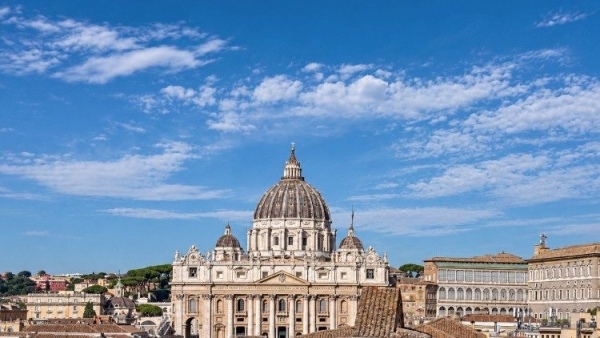 On November 18, the Church celebrates the Dedication of the Basilicas of Saints Peter and Paul—an observance that recalls the apostolic roots of the Christian faith and the profound significance of a sacred site as a space for prayer and communion. This year, the feast holds special meaning for the Vatican Basilica, as it marks the fourth centenary of the consecration of the current edifice.
Saint Peter's Basilica
There are places that safeguard the memory of faith and continue to speak to the human heart. St. Peter’s Basilica is one such place: even before being a monument admired by the world, it is a home where the Church recognizes itself and gathers around the memory of the Apostle Peter.
The Feast of the Dedication—celebrated on November 18, and marked by a Mass presided over by the Pope Leo XIV—underscores this very identity.
“To dedicate means to set apart for worship something composed of physical materials—stones, art, and colours. In the case of St. Peter’s Basilica—a site built to allow the community to celebrate Easter at the tomb of Peter—this takes on a significance that resonates throughout the entire Catholic world.”
Archbishop Vittorio Francesco Viola—Vicar General of the Pope for Vatican City and the Pontifical Villas of Castel Gandolfo, and Archpriest of St. Peter’s Basilica—reflected on the significance of this year’s milestone: the fourth centenary of the dedication of the current St. Peter’s Basilica, which was consecrated by Urban VIII in 1626.
Basilica opens the heart of God to the world
Four centuries of history and faith, expressed through art, “help us contemplate the beauty of Easter. Entering the Basilica means being enveloped by art that is entirely at the service of the liturgy; this dialogue—this intimate, profound relationship between such beauty and the beauty of the liturgy celebrated by the Church—allows us to feel closer to heaven.”
This is underscored by the millions of pilgrims and the faithful who arrive from every corner of the globe—people of diverse cultures, languages, and sensibilities—who make St. Peter’s a tangible sign of a Church that is open and welcoming.
“It is inevitable that those who cross the threshold of the Basilica as tourists may also become pilgrims, following the paths that the Lord opens within the heart of every man and woman so that they might reach Him.
The Basilica’s openness to the world is, in fact, the opening of God’s heart to the world. Ultimately, the place itself embodies this openness: a humble fisherman from Galilee made himself available for a profound encounter with Jesus—an encounter that transformed his life—and from there, he was sent out into the world so that it, too, might be reached by the Good News of the Gospel.”
Beauty that enshrines greatness
For Archbishop Viola, the history of the Vatican Basilica is “an unending tale of how the Church has sought to preserve this place, fully aware of the power that Peter’s testimony holds for the life of the Church itself. It represents centuries of care, stewardship, and even ingenuity—all directed toward ensuring that this place could express, through its beauty, the greatness it enshrines.”
The various initiatives organized for the fourth centenary of its dedication bear witness to this greatness.
“We have produced a volume that compiles a list of the painters and mosaicists who worked within the Vatican Basilica; leafing through it, one realizes just how much art and sensitivity are required to care for such a place,' he said. 'And this never fails to strike us whenever we enter the Basilica: its monumental scale—so harmonious that its true dimensions are barely perceived—and the rigor of its Renaissance forms, which nonetheless open up to the influence of Baroque staging, reveal what is almost a living organism. It grows as history unfolds, alongside the humanity that passes through it, bringing with it ever-evolving sensibilities.”
Safeguarding the site of Peter’s tomb
This year’s celebration is particularly significant for Archbishop Viola, who is experiencing it for the first time in his role as Archpriest of the Basilica.
“The first emotion that comes to mind is, without a doubt, a sense of gratitude toward the Holy Father, who entrusted me with the task of safeguarding the site of Peter’s tomb,' he said. 'I also feel great gratitude for all those who have cared for this place in the past—starting with Cardinal Gambetti, who has concluded his service and showed such special care for the Basilica. Then there are the many collaborators—from the sampietrini (the Basilica’s specialized technical staff) to those in administrative and management roles—all of whom are essential to the functioning of an entity as complex as this Basilica. I am deeply grateful to everyone who, in their various capacities, has looked after this place.'
“Beyond that, I truly feel the power of this site: being able to celebrate at the Altar of the Confession of Peter gives new momentum to the life of the Church. I hope this will be true for me, as well as for all those who will join with joy in the celebration presided over by the Holy Father.”
The Fabric of St. Peter
An integral part of the Basilica’s administration is the Fabbrica di San Pietro—an institution of the Holy See founded on April 18, 1506, by Pope Julius II to oversee the reconstruction, preservation, maintenance, and dignity of the Vatican Basilica.
Just a few days ago, the Fabric inaugurated the fifth edition of its School of Arts and Crafts. “I appreciate that the School of Arts and Crafts is being remembered, for it is an endeavour dedicated to passing on the skills and capabilities born of human ingenuity—spanning a wide range of trades, from mosaicists and masons to plasterers, carpenters, and blacksmiths. It is a transmission of knowledge and wisdom—acquired through the eyes and the hands—to younger generations, propelling us toward the future.
“This training school is no mere museum, nor is it confined to a static past; rather, it is a dynamic entity, open to the world and to the generations yet to come. It is guided by a sensibility that begins with the treasures preserved here, yet—driven by a missionary zeal for evangelization—constantly seeks to share what this place holds with the wider world.”
Gianmarco Murroni
Source: vaticannews.va/en