
The 16th Interreligious Encounter in the Archdiocese of Saigon, on the theme: Faith And Wisdom Interwoven
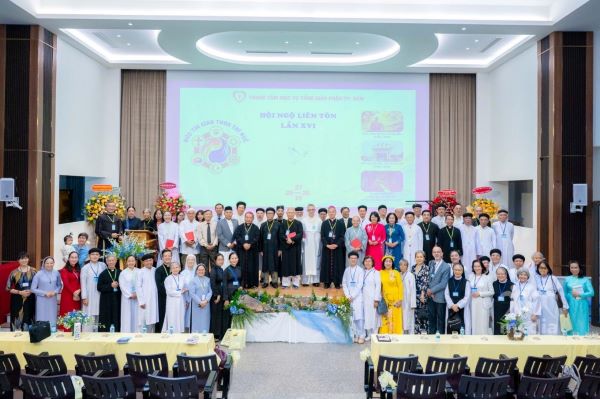 “Faith And Wisdom Interwoven” was the theme of the 16th Interfaith Encounter, held on the afternoon of October 27, 2026, at Cardinal Jean-Baptiste Phạm Minh Mẫn Hall, located at the Pastoral Center of the Archdiocese of Saigon.
The event was jointly organized by the Commission for Ecumenism and Interreligious Dialogue of the Catholic Bishops’ Conference of Vietnam and the Interreligious Dialogue Committee of the Archdiocese of Saigon.
Among those present were Archbishop Joseph Nguyễn Năng, Archbishop of the Archdiocese of Saigon and President of the Catholic Bishops’ Conference of Vietnam; Bishop Joseph Châu Ngọc Tri, Chairman of the Commission for Ecumenism and Interreligious Dialogue; together with priests, religious, religious leaders, scholars, and faithful from various religious traditions.
Building on the previous fifteen gatherings, this year’s program focused on the relationship between faith and wisdom, the role of religion in the formation of the human person, and the challenges posed by the development of artificial intelligence.
Opening of the 16th Interreligous Encounter
The program began at 3:00 p.m. with a dance performance entitled “Understanding and Compassion” (Hiểu và Thương), presented by the Sisters of the Lovers of the Holy Cross of Thu Duc. The performance expressed the theme and spirit of the gathering, which brought together faithful from nine religious traditions.
In his opening address, Archbishop Joseph Nguyễn Năng reflected on the relationship between knowledge, intelligence, and wisdom. He explained that knowledge enables people to understand things, intelligence helps them solve problems, while wisdom guides them in living rightly, harmoniously, and responsibly.
Addressing the development of artificial intelligence (AI), the Archbishop observed that technology can process information rapidly and assist in a wide range of activities, but it does not possess love, conscience, or moral responsibility in the way human beings do. Therefore, religions have a mission to help guide humanity in using knowledge and technology to safeguard human dignity, foster solidarity, and promote peace.
Following the opening address, Archbishop Joseph Nguyễn Năng and Bishop Joseph Châu Ngọc Tri performed the ceremonial beating of the drum and gong to officially inaugurate the gathering.
The participants then watched a video reviewing the fifteen previous Interfaith Encounters and explored the symbolic meaning of the 16th gathering.
Part I: Wisdom and Religion
To open the first session, the organizers screened a video introducing the life and achievements of the renowned Vietnamese scholar Lê Quý Đôn, marking the 300th anniversary of his birth (1726–2026).
This was followed by a presentation by Professor Thượng Tạo Thanh, representing the Cao Dai Tien Thien Institute, entitled “Faith and the Formation of Followers According to Cao Dai Teachings.”
The speaker introduced the historical development of the Cao Dai Institute and its approach to formation, which combines traditional methods with modern technology. According to Cao Dai teachings, the formation of followers should integrate the study of religious doctrine, moral cultivation, and practical service to the community. The Cao Dai dignitary also highlighted the importance of interreligious dialogue grounded in respect for differences while preserving the identity of each religious tradition.
Dr. Trần Kỳ Đồng, a lecturer at the University of Social Sciences and Humanities, then presented a paper entitled “AI and the Question of the Origins of Religion.” He examined the impact of artificial intelligence on the communication of religious teachings and the ways in which people receive spiritual guidance.
According to the speaker, AI can generate texts containing religious content, but it does not possess the lived experience, personal commitment, or moral responsibility that characterize human beings. This raises questions about the authenticity of religious content generated by AI and the responsibility of human beings in using this technology.
Following the two presentations, the Huong Sac Cham Group, representing Muslim faithful, performed the song “Habibi – The Creator Is Our Love.”
During the break time, participants had the opportunity to meet and engage in personal exchanges, as well as visit several exhibitions and cultural spaces within the Pastoral Center. These included the art exhibition “Faith and Wisdom,” the exhibitions “Light of the Nations” and “Treasures of Faith,” and cultural spaces dedicated to “The Way of Tea” and “Calligraphy.”
Part II: Faith, Education, and Spiritual Life
The second session began with the song “You Are Like Brightly Burning Flames,” performed by members of the Bahá’í community.
This was followed by a presentation by Sister Maria Teresa Avila Kim Trang entitled “Faith and the Mission of Education in the Christian Tradition.” Her presentation explored three key themes: education as an act of hope and charity; education as an integral part of the mission of proclaiming the Gospel; and education as a path toward holistic human development.
Drawing on her background as a lecturer in Confucian studies, Sister Kim Trang emphasized that Christian education involves more than the transmission of knowledge. It also helps learners recognize their own dignity, form their consciences, and develop a sense of responsibility. She also addressed the importance of guiding young people in the responsible use of artificial intelligence, encouraging them to be honest, verify information, and develop independent thinking.
The program continued with a solo performance on the Vietnamese zither (đàn tranh) by Sister Teresa Thúy Kiều, followed by the devotional song “Assalamu Alaika” (A Greeting of Peace Upon You), performed by the Huong Sac Cham Group.
Next, Venerable Thích Thánh Tâm, representing the Buddhist Sangha’s Committee for Nuns, presented a paper entitled “Wisdom and Faith in Buddhist Teachings.” She explored the relationship between faith and wisdom in Buddhist teachings, particularly through the process of learning, reflection, and practice as a means of transforming suffering and attaining a peaceful and joyful life.
Following this presentation, the student’s sisters from the St. Paul Nguyễn Văn Bình Institute performed the song “To Believe or Not to Believe.”
During the sharing session, Mr. Nguyễn Thanh Bình, representing the Bahá’í community in Vietnam, spoke about harmony and solidarity, emphasizing respect for differences and cooperation among religions.
Senior Brother. Chơn Minh Sơn, representing the Minh Đức Nho Giáo Đại Đạo community, highlighted the values of faithfulness and trust (Tín), benevolence (Nhân), and respect for differences in building human relationships.
The session concluded with a musical performance of “Under the Banner of Great Way,” presented by the the Agency for the General Propagation of Cao Dai Doctrine.
Part III: Praying Together for Peace
In the most solemn and spiritual part of the program, representatives of the various religious traditions took turns offering prayers according to their respective traditions. Their prayers were offered for world peace, those suffering because of war, the sick, teachers and students, and harmony among religious communities.
The prayer intentions also invited each person of faith to become a builder of peace in everyday life through listening, respect, forgiveness, and service to those around them.
Words of Appreciation and Closing
In his concluding remarks, Bishop Joseph Châu Ngọc Tri, Chairman of the Commission for Ecumenism and Interreligious Dialogue, expressed his gratitude to Archbishop Joseph Nguyễn Năng, the representatives of various religious traditions, the speakers, and all those who had contributed to organizing the event.
Reflecting on the presentations, the Bishop highlighted the distinction between having knowledge about religion and genuinely living out one's faith. He observed that artificial intelligence can synthesize information and assist in composing prayers, but it does not possess a life of faith as human beings do.
He encouraged the religious communities to continue praying for one another, sustaining dialogue, and working together in the service of humanity and the building of peace.
Following his remarks, Archbishop Joseph Nguyễn Năng and Bishop Joseph Châu Ngọc Tri presented commemorative plaques to the speakers and participants who had contributed to the success of the gathering.
The 16th Interfaith Encounter concluded with all participants singing “The Prayer of Saint Francis” (the Prayer for Peace) together. The organizing committee expressed its gratitude to everyone involved and looked forward to welcoming participants again at the 17th Interfaith Encounter.
Article: Sơn Nữ, SPC
Photos: Đăng Duy
Video: Media TGPSG
Source: tgpsaigon.net