
Treasure of Latin American Church: Saints, Blesseds recalled by Pope in Argentina
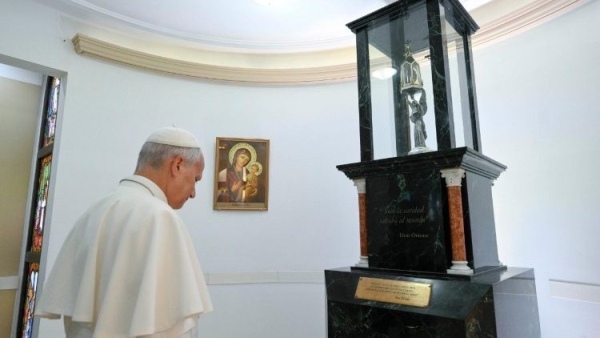 During his Apostolic Journey to Argentina, Pope Leo XIV recalls the Saints and Blesseds who helped shape the country’s spiritual heritage, as their holiness was lived in tireless service to those most in need.
Pope Leo XIV prays before the incorrupt heart of St. Luigi Orione in Claypole, Argentina (VATICAN MEDIA)
The logo chosen for the Argentine leg of Pope Leo XIV’s Apostolic Journey to Latin America gives visual expression to the many Saints and Blesseds of a country with a long Christian tradition and a history of welcoming others.
Small, stylized human figures of different shapes, sizes, and shades of color form a ring like the petals of a flower. They all turn toward the white cross at the center, a symbol of the kerygma that the people of God believe and proclaim.
This unity in diversity inspires a Church that continues to say “Bienvenidos a todos” (“Welcome, everyone”), as the motto of the visit puts it. It extends that welcome especially to the poor, the sick, migrants, and the weak, whom the Pope calls “rejected stones” in his encyclical Magnifica humanitas.
Enrique Ernesto Shaw: Bringing Gospel into industry
At his meeting with the world of work on Monday, November 9, at the Catholic University of Argentina in Buenos Aires, the Pope recalled the Venerable Servant of God Enrique Ernesto Shaw, describing him as a “Catholic businessman who experienced conversion after discovering the beauty of the Gospel.”
Born in Paris on February 26, 1921, into a deeply devout Argentine aristocratic family, Venerable Shaw lost his mother at just four years old. He joined the Navy at 16 and in 1943 married Cecilia Bunge, with whom he had nine children.
During a trip to the United States in 1945, he discerned a particular vocation to bring the Gospel into the world of industry, in which his family was involved through the company Cristalerías Rigolleau.
After becoming its managing director, he became known for his personal rapport with workers. “To judge a worker, you must first love him,” he would say.
In 1952, he founded the Christian Association of Business Executives and worked to promote a Christian understanding of the economy and social responsibility. He was also active in Catholic Action, the Christian Family Movement, and numerous works of apostolate and solidarity.
In 1957, he was diagnosed with a malignant tumor. Despite his illness, he continued working tirelessly in business, the Church, and society until his death in Buenos Aires on August 27, 1962, at just 41.
Mamerto Esquiú: Service in diocese and in politics
At Vespers on November 9 with the Bishops and synodal teams at the Metropolitan Cathedral of the Most Holy Trinity, the Pope spoke of “the witness of distinguished Argentine Bishops who devoted themselves to working for unity and peace.”
Among them was Blessed Mamerto Esquiú, who was born on May 11, 1826, in San José de Piedra Blanca.
In 1841, he entered the novitiate of the Friars Minor of the Province of the Assumption, making his religious profession a year later. He was ordained a priest on October 18, 1848.
Esteemed for his piety and moral integrity, he served as a deputy and a member of the governing council of Catamarca between 1855 and 1862.
In 1862, he moved to Bolivia as a missionary. Two years later, he was called to teach at the seminary in Sucre. In 1880, Pope Leo XIII appointed him Bishop of Córdoba, bringing him back to Argentina. He was ordained a bishop on December 12 of that year.
In the diocese, he was known for his deep life of prayer, his spiritual and material assistance to the poor, and his pastoral zeal and charity.
He trained seminarians, founded confraternities and associations of the faithful, preached retreats in the Spiritual Exercises, and led missions for the people. He died on January 10, 1883, in Posta del Suncho.
Enrique Angelo Angelelli Carletti: A voice against exploitation
At Vespers on November 9, the Pope also recalled Blessed Enrique Angelo Angelelli Carletti, who was killed along with three religious companions because of his tireless efforts to promote Christian justice.
Angelelli Carletti was born on July 17, 1923, in Córdoba. He entered the seminary in 1938 and continued his formation in Rome, where he was ordained a priest on October 9, 1949.
On returning to Argentina, he taught canon law and public ecclesiastical law at the seminary and carried out pastoral work at the Cathedral of Córdoba. He also provided spiritual support to young workers through his work with the Young Christian Workers.
He was appointed Auxiliary Bishop of Córdoba in 1961, and in 1968 St. Paul VI appointed him Bishop of La Rioja.
In his pastoral work, he paid particular attention to the poor and the rural community. He readily denounced injustice, abuse, and exploitation in public, often coming into conflict with those who wanted to protect their privileges and drawing fierce opposition and criticism as a result.
During his ad limina visit to Rome in October 1974, Pope Paul VI encouraged him to continue his work and make public gestures of clemency to help ease tensions. After the military coup in 1976, the persecution of Angelelli and his collaborators grew more overt and violent.
He died on July 4 as a result of a car crash near Punta de los Llanos. His death was long presented as an accident.
On July 4, 2014, however, an Argentine criminal court found that it had been a murder carried out as part of the military dictatorship’s repression.
Eduardo Francisco Pironio: A champion of World Youth Day
The third Argentine Blessed mentioned by Pope Leo XIV at Vespers on November 9 was Cardinal Eduardo Francisco Pironio.
He was born on December 3, 1920, in Nueve de Julio, into a family of Italian immigrants. He entered the seminary in La Plata in 1932 and was ordained a priest on December 5, 1943, at the Shrine of Our Lady of Luján, where the Pope celebrates Mass on November 11 in the square in front of the basilica.
Blessed Pironio studied in Rome at the Pontifical University of St. Thomas Aquinas. After returning to Argentina, he was appointed Auxiliary Bishop of La Plata in 1964 and was ordained a bishop in the Basilica of Luján on May 31 of that year.
He went on to hold important posts in the Church in Latin America, serving first as secretary and then as president of CELAM, the Latin American and Caribbean Episcopal Council.
He contributed significantly to the preparation and proceedings of the 1968 Medellín Conference in Colombia, which was crucial to the renewal of the Church in Latin America.
In 1972, he became Bishop of Mar del Plata. He then returned to Rome at the request of Pope Paul VI, who appointed him Pro-Prefect of the Congregation for Religious and Secular Institutes in 1975.
Pope Paul VI created him Cardinal in 1976, and St. John Paul II later confirmed him in his post at the Congregation.
In 1984, he was appointed President of the Pontifical Council for the Laity and focused its work on formation, communion, and participation. He took a particular interest in young people and played a decisive role in the beginnings and development of World Youth Day.
That same year, he was diagnosed with prostate cancer. Despite his illness, he continued his ministry with great dedication. He died in Rome on February 5, 1998. His remains were later transferred to the Marian shrine in Luján, Argentina.
Vatican News
Source: vaticannews.va/en